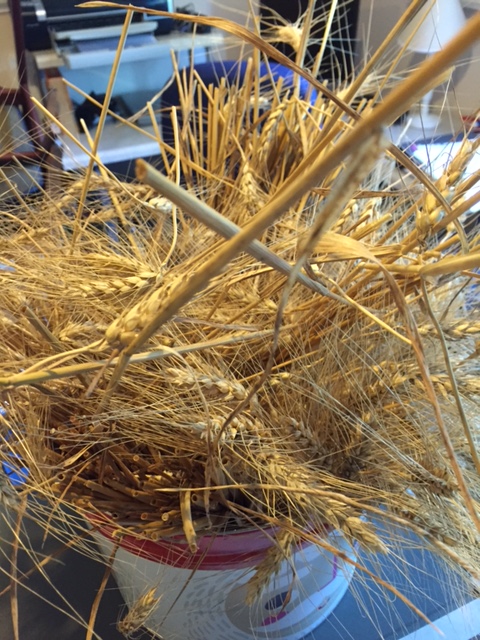
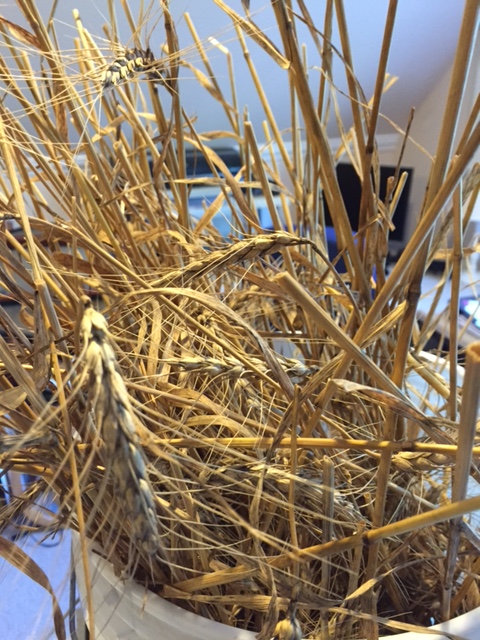
Impeller pressed sunflower oil, DIY

Background

With the recent cold and rainy weather, I finally had time to try out making my own sunflower oil. Using the press I built (see the older post on sorghum syrup), I followed the instructions on this site:  http://journeytoforever.org/biofuel_library/oilpress.html

I used oilseed purchased on Amazon, spendy but I got a load of seed for experiments and for fridge saving over a few years. There’s enough to sow a large plot with enough plants to generate a years supply of oil. My biggest issue was pests, mostly finches but also deer and squirrels. Once you have a large enough plot, there’s not enough pests to get the whole thing, assuming you put up a fence to keep the 4-legged critters out. Birds will eat as much immature seed as they possibly can, they are voracious pests so plan on loss unless you can add plastic mesh overhead.

The process

Starting with cleaned black oilseed, use a kitchen blender to shred the whole seeds until it turns into coarse flour. You can only do about a half quart at a time, once the flour forms the whole seeds stop getting to the blade.  Heat the flour up in the oven until it gets to about 150 F, this allows the oil to become less viscous and flow out of the slug inside the press. Don’t be afraid of overheating it, it cools down quickly and you really need a hot press to get the oil out. It will help to preheat the press itself, it will keep the slug warm. You will also want to add heat to the press with a heat gun, to keep it from cooling off.

Load the press full, then compress it by hand to pack as much in as you can. The sleeve will compress 3-4 times in volume, so expect that. You will also need a very large force, I used a 2 ton hydraulic press for the pressure. This was just adequate, the press was binding and at the limit of what I felt comfortable with. Still, it worked very well but could use refinement.

Towards the end of the pressing

I initially got nothing out of the slug, I was thinking “this is a bust” but it finally began flowing out the ports. It took a while, applying heat, cranking the press, and letting it rest. It eventually compacted to an end stage where no additional oil flowed, that’s time to collect and filter the oil.

IMG_1869

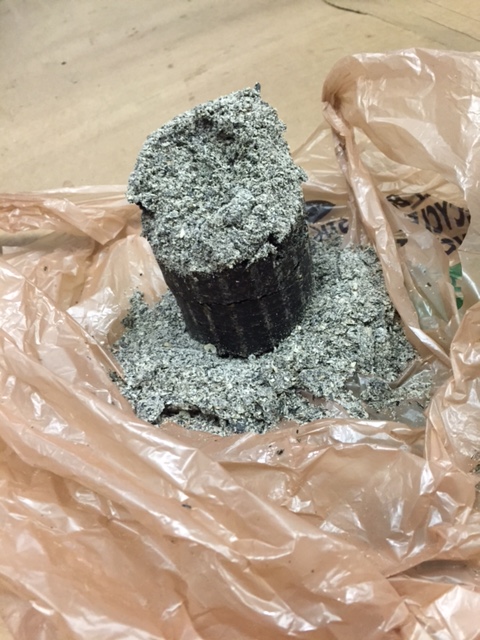
The spent slug (turd to some LOL)

Looks like wood ash, but it’s just the flour. It is as hard as a rock, and requires a large screwdriver and mallet to break free from the press sleeve. Lots of people complain about this, the little screw presses are really tough to clean from what I hear. I’m also not sure they generate enough force to clear all the oil from the “cake”.

IMG_1871

Collecting and filtering

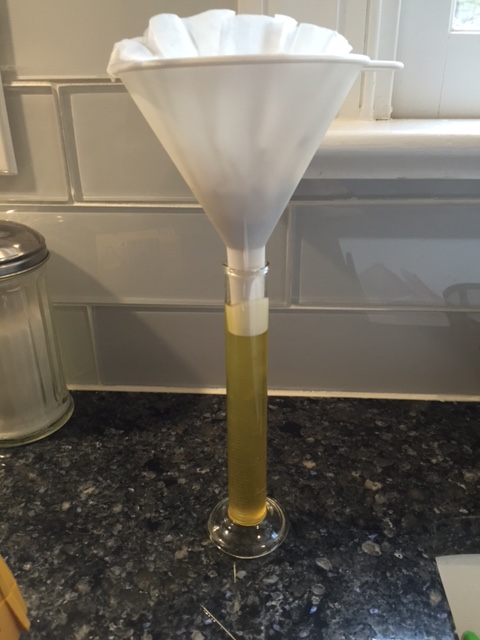
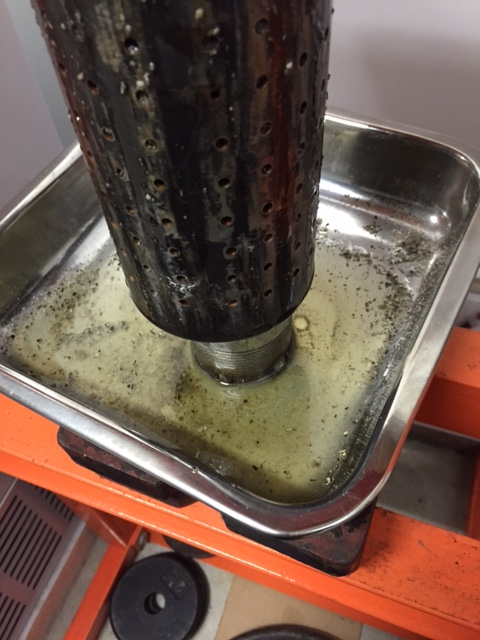
I heated the pan, and poured the hot oil into a coffee filter lined funnel on top of a 25 mL graduated cylinder. I wanted to accurately measure the yield, and I got just about 50 mL from a quart of loose seed (not flour). This seems to be about the right yield, looking at reference site’s numbers. It looks great, nice and clear but took overnight to clear the last of the oil through the paper filter. Coffee filter are around 15 microns, this is too small for a gravity filter and especially oil. I will get a 25 micron mesh and see how that goes, I don’t recommend paper for an oil filter unless you pressurize. Next steps are to fry some stuff in the oil, it’s in the fridge waiting for the test. Supposedly oil will turn rancid quickly at room temps, so I’m being cautious.

IMG_1872


Progress on the sorghum, corn, and sunflower plot

The small plot I made at work is doing well (mostly). I planted about 50 oil seed sunflowers, 25 Sugardrip Sorghum (milo) plants, with Tophat and Painted Mountain corn. These were a few of the essential crops I needed for long-term use, so I wanted to see how they faired in an area similar to a suburban front yard. That’s pretty much what this land is, so it was a perfect proxy for the experiment.  If hard times occur, we would need to plant every usable square foot in order to get by. Here’s the pics:

Sorghum

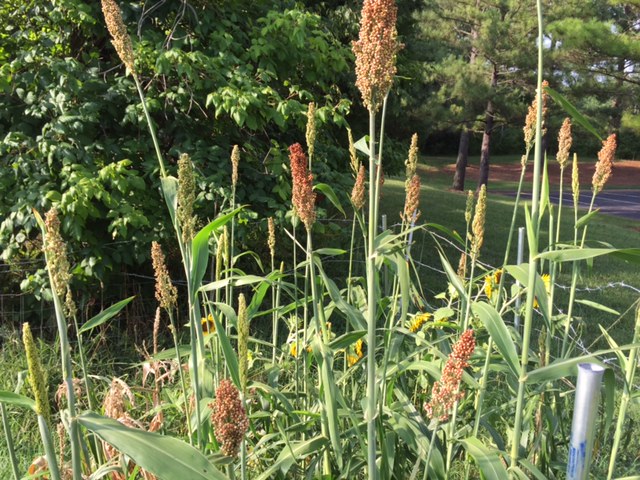
IMG_1553Beautiful!! nice tall stalks, big seed heads which is exactly what you need. It didn’t need much care, just some water in the beginning and a small shot of nitrogen. I need to get a few stalks out and press them for juice, I may have gone past the optimal syrup point but it might work. The seed will be kept for planting, and the rest milled into flour. I’ve never eaten millet, but apparently it’s a staple in developing countries. Sure is easy to grow, so mark this as a win. Flour and syrup from the same plant, what more can you ask for?

Sunflowers

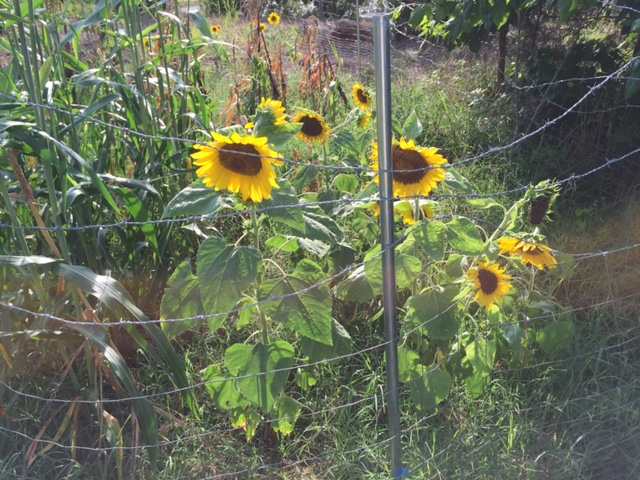
IMG_1552All the plants are growing well, but they are short compared to what I’m used to. This is a new variety, so maybe that’s the way it was bred. I had a problem with deer cropping the leaves, they pushed the fence in and over the plants, and where they couldn’t do that they leaned over and did it. I ran three strands of barbed wire up some posts, fixed that problem.  You can see it in the pic, works great but is a killer to work around. I see how a spiral of this loosely staked would stop intruders, the barbs are sharp as hell and snag anything. You would be totally stuck hitting this stuff, and I am keeping a roll in stock just in case. Good luck getting past it.

Corn

Sadly, the corn is not doing that great. All the plants are stunted, and the ears that made seem to be small and partially developed. There was a lot of fungus in the ears, and a lot of them were sprouting when I pulled them. I have plenty of seed now, but eating would be problematic. I don’t know exactly why this happened, but I think it’s a lack of nitrogen (corn is a grass) coupled with the wrong variety for this area. I think these were developed for places like the Pacific Northwest, or cool short seasons. I’ll try this again, using a different one and of course dressing the shit out of the fertilizer. I’m amazed how much you need to grow wheat and corn, I didn’t think it was that critical but it is. Which is an important lesson; make sure you have a big barrel of fertilizer on hand or you can’t grow the traditional cereal grains. Maybe you could use dung or compost, but that’s a luxury and won’t be handy initially.

Scythed Wheat

Winter variety. This turned out absolutely perfect, great yield and well formed heads. No rust or smut. Win!

IMG_1556

Spring Variety.  Started out well, but didn’t grow as robust as the winter and developed a slight dark coloration on the heads. I think it’s a fungus, it wasn’t wet (actually dry) but it appeared when it was ripening. It seems to be just the husk, the kernels are OK but I’m leery of any grain fungus. Ergot is a common rye problem and causes horrible health problems if consumed.

IMG_1555

Miscellaneous stuff

The herb garden is rocking. Basil, oregano, thyme, chives, dill, etc. All doing well, and boy they sure taste good. I never had fresh spices, these are the best.  I added a blueberry bush to the berry patch, yielded a good crop and I learned that you need plastic mesh if you want to keep any. Catbirds and robins go for any berries, so lesson learned.   Broccoli is still sucking, I gave up trying to spray for caterpillars. I think the only way to stop it is to make a house screened enclosure over the plants (next year).

Lots of plants made seed; I harvested onion, kale, broccoli, wheat, bell pepper, and now carrots and basil (waiting for them to dry). I need to successfully grow a crop from seed before declaring victory, that is in progress. Already did hot pepper and cherry tomato, the trick was to let the fruit drop and overwinter in the dirt. Drying them didn’t work, supposedly there’s a coating on the seed that needs to be there for it to germinate. More work needed on those, I guess.

Five food items we can’t live without (literally)

I was putting the final items on my last BePrepared supply order, and it occurred to me that I had totally underestimated my need for salt. For some reason, I figured 2 cardboard cans of Morton’s would be plenty (that’s about 3 pounds). I started calculating daily usage, times my family for a year and that came to 25 pounds.  Yikes…sure missed that one.  So I added enough to cover me conservatively for a year or more, it’s cheap as heck and compact. 

You simply can’t survive with no salt, so this goes to number two on the must-have list behind clean water. 

 Number three is probably sugar.  Once a crisis is underway, that will be difficult if not impossible to obtain, and it goes in just about every kind of food imaginable. Daily sugar intake is at least double salt, so I went with 60 pounds.

 Number four, probably powdered milk. No way to get dairy unless you own one.

 Number five, powdered eggs. 

 Everything else you can grow, make, or gather. Spices, oil, nuts, fish and game,  wheat, vegetables, beer, vinegar, yeast (sourdough), etc. I keep going back to the mental image of a homesteader packing the Conestoga to make the journey out west, they had far less sophisticated things but managed OK. 

Mid-term emergency planning

We’ve discussed short term planning and prep in a previous post, the next phase begins roughly 20-30 days after the event and lasts until you can achieve sustainability. Recall that the short-term will be covered by a relatively moderate amount of preparation and supplies, augmented by whatever you have on hand or can grab prior to the depletion of local stores. That will represent the last link to normal and familiar existence, after that runs out you will need to shift to a much more labor intensive routine. Most of us take advantage of prepared foods and many modern conveniences, none of which will exist. There are a number of categories to consider:

  • Heating
  • Power
  • Cooking
  • Water
  • Food
  • Sanitation
  • Self-defense
  • Shelter
  • Fuel
  • Transportation
  • Human interaction

It’s sort of a “OK I made it this far, now what?” scenario.  Up to that point, chances are it will seem like a camping trip or the aftermath of a hurricane; not a lot of work just consuming supplies. The next phase will need to last long enough to get things ramped up to allow existing on what you can grow and collect in and around your dwelling.  That’s the Day366 idea, maybe it’s Day183 but same principal. At some point, no matter how much stuff you hoard you will run out. That will be primarily food related items, the rest is less critical and beyond the scope of this blog. To a large extent, other things will become available as people move on (both figuratively and literally). For instance, say 5 months later you need some nails. The local Home Depot will probably have lots of them, you can’t eat nails and they are useless to looters.

I’m going to cover the last item of my list first, Human Interaction. This might be the most important one, since your survival could depend on who shows up at your place.

Human Interactions

There’s a new movie out called “American Blackout”, I don’t plan on watching it but the plot revolves around a cyber-attack on the power grid. It covers the first 10 days, but I’m not sure if it assumes the blackout lasts longer than that. This made me think (again) about how people would respond in a crisis, and how my planning would be affected.  Frankly, I have a very tough time imagining what others will do. We all tend to assume people will behave in a certain fashion, either like us, helpless incompetents, or as criminals.  That’s the sense I get visiting prep sites, maybe that’s correct but no idea, really. I’m going to try to be open-minded and think this one through.

Neighbors

These folks are, by virtue of proximity and familiarity, going to be the first to come a ‘knocking.  I expect them to be out and about and seeking help and information from the start of the crisis, it’s only natural but begs the question of how to respond.  On one hand, if outsiders cause trouble you may want to band together for protection. On the other, chances are they will only drain what limited resources you have and expect you to help even if you can’t. My position is to offer guidance, information (you may be the only link to the outside), and assistance defending against outsiders.  Say nothing about what you have, that will create a terrible problem later. I’d like to be able to function as Farmer Bob and feed the subdivision, but that’s not practical. So, the only reasonable path is to defer food requests and make them find it themselves. I could probably provide clean drinking water, assuming they bring it to me for filtering and treatment. I could also give them a few seeds, if they can plant and maintain a garden.  You have to force people to shift for themselves, otherwise they will do nothing and expect to be taken care of. Sound harsh, but there’s no other way to handle it.  It’s the old saying about teaching someone to fish rather than giving them one…

The exception to this is block defense, if strangers begin roaming and looting houses you may need to form a team to repel them. I suppose it would be like a tiny version of the Minutemen, those who own firearms respond to the call. That assumes your neighbors are not royally pissed off at you and/or are the ones doing the looting.

What I’d really like to do is organize the nearby homes, pool resources, and get cranking on the gardening/farming/wood cutting/improvising.  Whether or not I can convince people to follow that is a big question, but they’d have few options.   Beats me if this is feasible, or it breaks down and we end up in Mad Max mode after all.

Outsiders

This is the land of pure speculation. I’m not sure if too many outsiders would show up, given the difficulty of travel and resupply. If they did, I would stay quiet and wait until they left. If they caused trouble, warn then dispatch. I don’t see how you could tolerate any form of looting, that defeats the whole purpose of prepping and would cause you to lose everything you worked so hard to put in place.  ‘Nuff said there.  One complication would be cops and armed forces, if they started commandeering private property under some bullshit law it would put you in a real bind. I could just see the local doughnut eaters trying this, although I doubt it would be successful. If the armed forces do it, maybe better equipped but still facing resistance from heavily armed homeowners. Same approach, hide then attack if they persist.

Food

Learning from my storage experiments, here’s what I recommend as the food options:

  1. Freeze dried entrees, veggies, fruits. This stuff is reasonably priced, stores for up to 25 years, and has enough variety to prevent food monotony. How much is up to you, but I suggest at a minimum three meals a day per person for 3 months. This, added to the short term stock plus things I list later, should get you to the 6 month or beyond mark. http://www.beprepared.com is a good source of these items, I’ve been very happy with them.
  2. Freeze dried basics. You will want to augment the entrees with some staples, like potatoes, soy protein meat substitutes, powdered eggs, powdered milk/butter/sour cream/tomato paste, etc. These allow you add in simple sides and also make things like pasta sauce from long term stores. This will stretch out your entrée selection and use things like rice, beans, and pasta in normal dishes rather than prison camp fare.  What’s for breakfast? Beans. Lunch? Beans. Dinner? Get ready….RICE! Yay!  Need to avoid that trap. http://www.rainydayfoods.com/ is a good source for all this.
  3. Grocery Store items. You don’t need to buy everything in sealed cans, here’s a sample of what can be safely stored in Ziplock bags and boxes:
    1. Pasta.
    2. Rice
    3. Baking powder
    4. Yeast
    5. Salt
    6. Sugar
    7. Spices
    8. Cocoa
    9. Dry soup mix
    10. Potato flakes
    11. Canned meat. Note: this needs to be stored separately, rotated and checked. The cans do corrode and the result is a disaster.
  4. Grains and legumes. Sold as a kit by BePrepared, contains a years supply of misc grains. Highly recommended, but note requires a grain mill for the wheat and oats.
  5. Oils. I’m still working on this, but so far the leading candidate is coconut oil. It’s almost fully saturated, is a solid below 75 F, and is said to keep for 6+ years if kept cool, dark, and unopened.  Plain corn oil is OK if you check it, but this is a work in progress.  BTW you MUST have some kind of fats and oils in your diet, plan on looking like the Olsen twins without it.
  6. Powdered drink mix, coffee.  This falls under the monotony rule, it is said that drinking just plain water leads to dehydration, esp. with kids.  Packets and jars of Koolaid and chocolate milk store well and are easy to make.

Heating and Cooking

Really the same thing, you probably will be using the same item as a heat source and for cooking. The best approach is a propane burner, this can be run indoors with no smoke. Downside is the need to stockpile gas, but some quick ciphering leads you to about 8-10 15 lb cylinders as a minimum. That’s not bad at all, and highly recommended. Using a Coleman camp oven on top the burner gives you a small volume stove.

Alternately, you can purchase a cheap wood stove and pop for the Lehman’s Amish oven. This is a lot more hassle, you have to run a chimney, cut and season wood, and will create a giant signal that says “go here to pillage”.  It’s totally non-stealthy, and really belongs in the Day366 section but thought I’d mention it.

Stay tuned for more when I get motivated to finish this post….
“The Book of Eli” movie review as related to disaster prep

I recently watched the “Book of Eli”, it came on after another movie I wanted to see. I normally wouldn’t have bothered (too depressing) but the opening scenes caught my attention. It was actually pretty good as entertainment, but not at all realistic IMO. I won’t detail the entire film, but it’s abount a guy who is carrying a Bible from somewhere in the interior of the US to the West Coast, after a generic apocalypse.  There a a few things I thought were accurate:

  • Water was the number one commodity. It was all about filling up that canteen, which is pretty much what combat troops with no supply tail do.
  • Footwear is number three. No transpo, means hoofing it everywhere. Eli was all about scrounging better boots, again a prime factor for infantry guys.
  • Hygiene was number four. Shampoo and soap was the gold of the future, which again jibes with most veteran accounts of being on the line and dreaming of getting clean. I feel nasty after a day or two, weeks and months I can’t imagine.

What was silly:

  • Bandits living in the middle of nowhere after 31 years of anarchy.
  • Victims of said bandits oblivious to danger, including unmuffled motorcyles.
  • Viable 31+ year old batteries, bullet primers and powder, vehicle tires, and gasoline.
  • Road Warrior as a lifestyle. I am pretty sure people would hang all miscreants on sight, it would be all about cooperation and not lone wolf tactics. Makes for a good film action I guess.
  • The strangely sociable prepper cannibals with no prepared firing positions or defensive fortifications.  Surely they would have expected trouble and sandbagged a room or two, and kept a lookout for intruders. I enjoyed how the bad guys DROVE UP, got out of their vehicles, then engaged in a dialog with the heavily armed occupants while casually setting up a Gatling gun. Huh? 4 people inside, please pick off all standing right away BEFORE WE ALL GET WAXED!  I especially enjoyed Denzel’s line “..I expect they are up to no good.” Yeah no kidding, Mr. Wizard.

Response at the local and individual level

We discussed how the larger government functions may cease to operate, or at a very basic level (perhaps just units of the US military). This will result in the following:

  • Food, specialized medical supplies, and gasoline/fuel quickly become unavailable. Most vehicle transportation is halted.
  • If enough critical workers leave their jobs, public utilities (water, sewer, and electric power) go down leaving people in the freezing cold and dark with no clean water.

Just losing the electric grid will cause this, since everything is driven by motors and pumps.  Is this too pessimistic? Maybe, but even if the effect is temporary it will be the worst thing to happen in our lifetimes.   At the very least we should be prepared to ride out this situation for a period of time, to stay alive.  Unfortunately, the majority of people do not this seriously and won’t make preparations. This leads to speculation as to what the response would be at the local and individual level.

Ideally, people would stay home, break out the supplies, and let things get back to some semblence of normality. Instead, they will likely be forced to leave in search of those fundamental items or end up as casualties. I suspect many will try to get to some relief center, if it exists.  As I mentioned in the Guns ‘N Ammo post, the lack of transpo and supply will limit how far people can travel foraging. Whether they start going door to door and/or turning violent is anyone’s guess. In any case, trouble would probably come from neighbors or those in walking distance. Here’s a few things to contemplate (and I sure don’t know the answer):

  • Would normal people start breaking into houses and killing the occupants for provisions?
  • Being armed and having some perceived authority, would the local gendarmes do this? Some of this went on in Katrina, so it’s not unprecedented.
  • Would people band together for mutual support, and would they then try to overpower other people or bands?
  • Would local government attempt to confiscate private property in the guise of the common good?

People are generally fairly adaptable and tend to lend support for others, even in desperate circumstances.  There’s not much data on how this might play out, other than in wartime (seige of Leningrad, 1944 Holland, Germany). In those cases, a central government still existed and the country was fully mobilized with Red Army or Nazi troops in place to put down any lawbreakers.  Bottom line is now, here in the US, we don’t know.  But we can guess at some likely scenarios, then prepare to them.  Here’s my shot at it:

Emergency begins. For a short time, people behave and can carry on in a somewhat normal fashion (as in a hurricane recovery).  As food runs out, stores are looted, first in urban areas then suburbs. Grocery, convenience, home improvement, gun stores cleaned out. As those supplies are depleted, what government is left tries to setup distribution centers/shelters. People go those, there are way too many for the limited supply and they are overrun. At this stage, they either return home to scrounge or wait for relief. Neither option is workable, and thirst and/or starvation sets in.   Time frame and casuality rate depend on the situation, could be weeks, months, or years and fractions a percent to near-100% respectively.  Recovery depends on the ability to sustain a population from whatever is left.

Thinking about this makes me realize there’s no way to know what you’d be faced with, you just have to plan for a potentially long term crisis.