Results of the 2018 storage check

It’s that time again, it’s already been close to 5 years since I last cycled through the mid-term storage items.  I had checked my boxed up freeze dried stuff back in 2016, but I didn’t do a detailed check of the bins where I save the grocery store type stuff. Here’s the highlights:

  • Kool Aid packets. Fail. They picked up up moisture and formed a puck inside the packets, plus they changed color and got some green specks which I’m pretty sure aren’t flavor crystals. These may have been from 2005, so I can give them a pass but they don’t last all that long sitting around.
  • Gel deodorant. Fail. Turned into liquid, thankfully they stayed sealed.  Same thing, 2005 vintage, but I’m going to solid stick now.
  • House brand liquid dish soap. Win. Perfect, from 2005.
  • Book matches, 1000. Win. Had rusty staples but struck like new. 2005.
  • Flour and corn meal.  Fail.  Picked up moisture and odors from other items. 2013.
  • Sugar (bag). Fail. Moisture on the bottom of the sack. 2013. Guess it’s hygroscopic.
  • Peanut butter. Win.  Looks and smells perfect, 2013. This will go back into storage until 2022, it will get pitched then. I pick up 4 huge jars every 4 years.
  • Oil. Win. Looks and smells perfect, 2013. Same as the PB, 8 year life. 
  • Yeast packets. Win.  Looked and smelled great, and proofed just fine. 2005. I’ve since switched to glass jars, but the packets held up. A big surprise, everyone claims they go bad but apparently not.
  • Aspirin. Fail. The pills had crystal whiskers growing out of them, and were clumping together, 2005 . I figured aspirin would last for decades, guess not.

Funny how many things go bad after a few years, even when you try to keep them in a favorable environment. This is one of the things apocalypse movies get wrong, things just don’t last.


A fast sand water filter

One of the things I definitely needed as part of my big plan was a way to prefilter raw water. In treatment plants, water is pumped into settling tanks with aeration and flocculant to get all the particles out, then it goes to finer filtration and chlorination. In my scheme, I didn’t have anything ahead of my Berkey ceramic filter which would tend to limit the throughput for drinking water (clogs from sediment). It also didn’t allow for a source of filtered but non-potable water for washing.

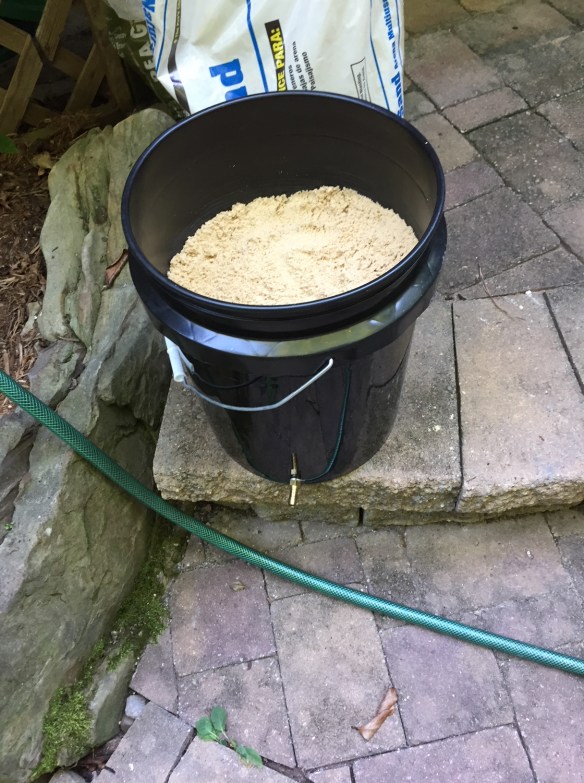
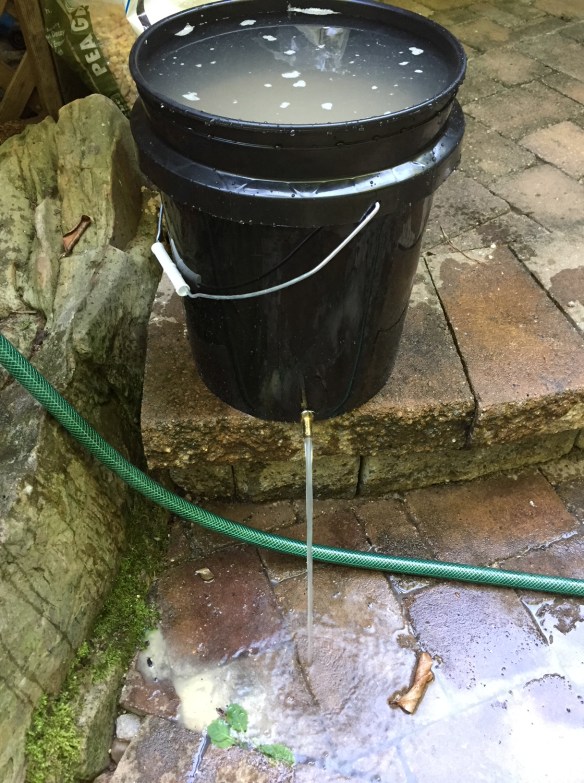
The usual solution for filtering is a “slow sand” filter, it’s a large column of sand with a diffuser on top and a drain at the bottom. It’s big and heavy, they need to be at least 55 gallons to allow the bacteria to trap and digest any harmful impurities. It is also slow, just a trickle, and also needs to be run for a while to develop the native biofilm. Rather than do all this, I made a smaller version that just traps particles. The goal was to pour asswater in the top, and get clean non-turbid stuff out for either bleach treatment (washing) or for the Berkey and Pur filters for drinking and cooking.  Here’s a few pics:

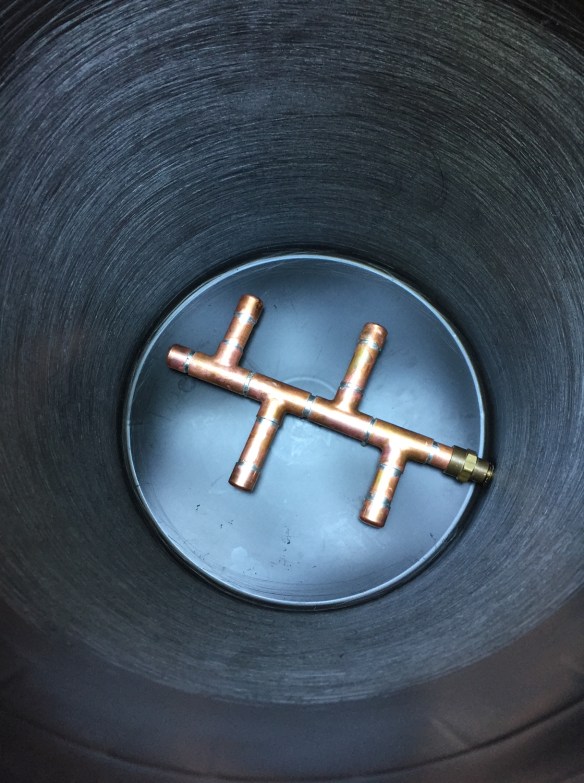
Empty plastic bucket with the copper manifold and outlet

IMG_2402

A couple of notes. I used 40 grit paper on the sides, this is to trap the sand grains and not let any water past the sides. This is a big deal with the slow filters, so I went ahead and treated it. The pipe manifold is copper, there are a bunch of 1/8″ holes underneath that let the water out. I used copper for the antimicrobial properties and easy assembly, but plastic would be fine.  I added a 3″ layer of pea gravel on top of this, to prevent the sand from migrating out the manifold.


IMG_2403

Here it is with the pea gravel and play sand fill. I left about 1 1/2 gallons of headspace to give it some working volume, but still have a filtering action.

IMG_2404

In action. You can see the fine sand it spit out on the first fill, that went away quickly and the rest was crystal clear. Playsand is very fine, almost dust like, and seems to do a good job filtering sediment. I pulled a bucket of pond water, let it sit a few days, then poured it in. Out came nice clear water, albeit with a faint musty lake smell.  This will be run through my other filters soon, and I’ll see how it is. I think using an aquarium bubbler on the filtered water might eliminate the odor, will probably try that as an experiment.

So far, so good though.


Filling in the preparedness plan gaps

I’m sort of done with the big picture planning, and now I’m going back to see what sort of gaps exist in my 1 year plan. I did this by creating a master Excel sheet with every plan item listed, with the quantity/storage location/justification for the amount. Once I did that, it was apparent which things were either missing or short. For instance, I had toiletries and hygiene items but had missed on the amounts and type.  Toothpaste and floss was short, and the wrong type (need powder for long term storage). Toilet paper was another. Once you get it all on paper, you can mentally run through everything you use regularly and see the issues. Calculating your usage is a must, and can be done within the sheet which is handy. One thing that tripped me up is my kid’s needs, when I first started they were preschool/elementary age but now are teenagers. That add two adults to the list, with different needs.

I am getting close to finishing up the 1 year prep plan, most things are in place and it’s a good feeling.  There is the question of how long to plan for, there’s nothing magic about a year but LDS uses it and it is a reasonable time frame.  Anything longer than that would either have to be dealt with by going full homesteader or going nuts on the amount of stored items. I just can’t see a reasonable scenario where I’d need 3 or 5 years with no outside supply or ability to grow food.

As a note, it’s time again to purge and check stock on my 2005 and 2013 items. I had socked away some things long ago that weren’t really meant to last, but they seemed to hold up OK externally. I’ll be sampling things and reporting back, stay tuned for that….


Progress on the sorghum, corn, and sunflower plot

The small plot I made at work is doing well (mostly). I planted about 50 oil seed sunflowers, 25 Sugardrip Sorghum (milo) plants, with Tophat and Painted Mountain corn. These were a few of the essential crops I needed for long-term use, so I wanted to see how they faired in an area similar to a suburban front yard. That’s pretty much what this land is, so it was a perfect proxy for the experiment.  If hard times occur, we would need to plant every usable square foot in order to get by. Here’s the pics:

Sorghum

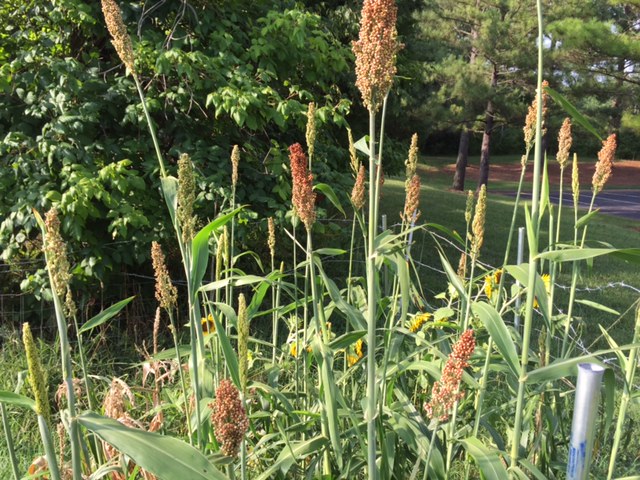
IMG_1553Beautiful!! nice tall stalks, big seed heads which is exactly what you need. It didn’t need much care, just some water in the beginning and a small shot of nitrogen. I need to get a few stalks out and press them for juice, I may have gone past the optimal syrup point but it might work. The seed will be kept for planting, and the rest milled into flour. I’ve never eaten millet, but apparently it’s a staple in developing countries. Sure is easy to grow, so mark this as a win. Flour and syrup from the same plant, what more can you ask for?

Sunflowers

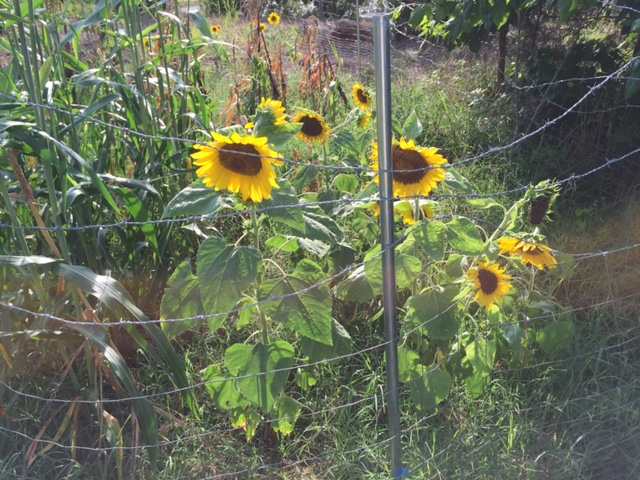
IMG_1552All the plants are growing well, but they are short compared to what I’m used to. This is a new variety, so maybe that’s the way it was bred. I had a problem with deer cropping the leaves, they pushed the fence in and over the plants, and where they couldn’t do that they leaned over and did it. I ran three strands of barbed wire up some posts, fixed that problem.  You can see it in the pic, works great but is a killer to work around. I see how a spiral of this loosely staked would stop intruders, the barbs are sharp as hell and snag anything. You would be totally stuck hitting this stuff, and I am keeping a roll in stock just in case. Good luck getting past it.

Corn

Sadly, the corn is not doing that great. All the plants are stunted, and the ears that made seem to be small and partially developed. There was a lot of fungus in the ears, and a lot of them were sprouting when I pulled them. I have plenty of seed now, but eating would be problematic. I don’t know exactly why this happened, but I think it’s a lack of nitrogen (corn is a grass) coupled with the wrong variety for this area. I think these were developed for places like the Pacific Northwest, or cool short seasons. I’ll try this again, using a different one and of course dressing the shit out of the fertilizer. I’m amazed how much you need to grow wheat and corn, I didn’t think it was that critical but it is. Which is an important lesson; make sure you have a big barrel of fertilizer on hand or you can’t grow the traditional cereal grains. Maybe you could use dung or compost, but that’s a luxury and won’t be handy initially.

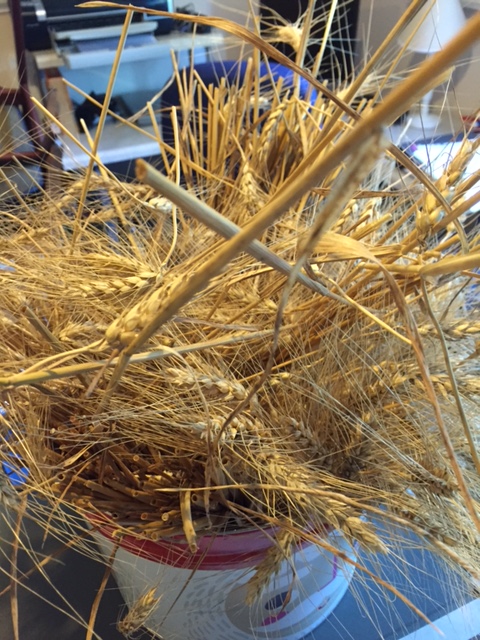
Scythed Wheat

Winter variety. This turned out absolutely perfect, great yield and well formed heads. No rust or smut. Win!

IMG_1556

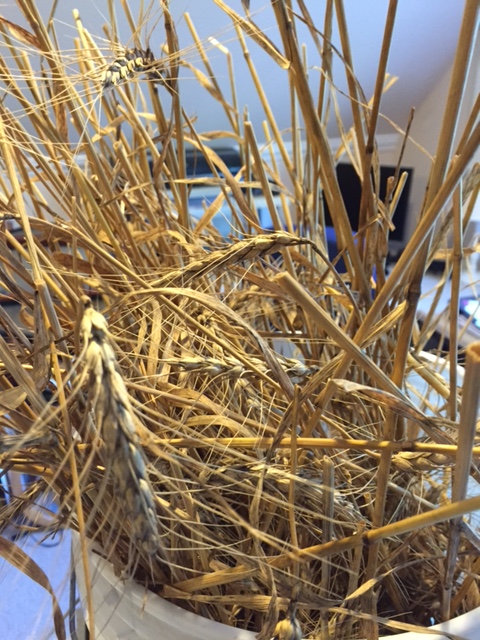
Spring Variety.  Started out well, but didn’t grow as robust as the winter and developed a slight dark coloration on the heads. I think it’s a fungus, it wasn’t wet (actually dry) but it appeared when it was ripening. It seems to be just the husk, the kernels are OK but I’m leery of any grain fungus. Ergot is a common rye problem and causes horrible health problems if consumed.

IMG_1555

Miscellaneous stuff

The herb garden is rocking. Basil, oregano, thyme, chives, dill, etc. All doing well, and boy they sure taste good. I never had fresh spices, these are the best.  I added a blueberry bush to the berry patch, yielded a good crop and I learned that you need plastic mesh if you want to keep any. Catbirds and robins go for any berries, so lesson learned.   Broccoli is still sucking, I gave up trying to spray for caterpillars. I think the only way to stop it is to make a house screened enclosure over the plants (next year).

Lots of plants made seed; I harvested onion, kale, broccoli, wheat, bell pepper, and now carrots and basil (waiting for them to dry). I need to successfully grow a crop from seed before declaring victory, that is in progress. Already did hot pepper and cherry tomato, the trick was to let the fruit drop and overwinter in the dirt. Drying them didn’t work, supposedly there’s a coating on the seed that needs to be there for it to germinate. More work needed on those, I guess.

Geiger counters and Black Swan events

Now that I have a lot of my mid term plans and supplies done, I’m looking at long term, mobile operations, and “second-order/Black Swan” scenarios.  By that I mean things that can happen, but are not as likely and not worthy of attention until everything else is done.   One of these is a nuclear exchange or a long term loss of grid power (nuclear fuel fires). For that, I still need everything I already talked about but also a way to detect gamma/beta radiation and some type of fallout shelter.

Detectors

There are three types of radiation detectors on the market; new lab grade survey meters, low cost Geiger counters, and government surplus. The problem with the first is expense, to cover the range expected in a crisis would take thousands of dollars. You can’t get a decent instrument that will cover 1 mR to 500 R/hr, the closest I found was Ludlum’s in Texas but they are not really customer focused and you’d need add ons to get the range. Plus it’s expensive.

Amazon/Ebay stuff is usually gimmicky/low cost with a low max rate, usually less than 0.1 R/hr which is OK for things like high school science lab but not for even low levels of fallout. You have no way to know whether or not you’re getting 1 R/hr or a 1000, which is the difference between living and dying.

And then there’s CD surplus. It seems there are large stocks of 60s/70s Civil Defense meters being released into the surplus channels, so one can pick up bargains. BUT, these things have been sitting around for 50+ years with a lot of it inoperable. I was lucky to find this guy:

http://www.uraniumrocks.com/

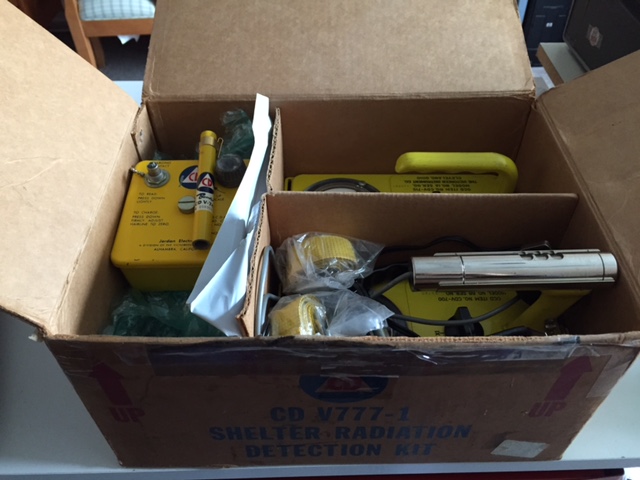
He has repaired and checked CD-700/715 meters and dosimeters, plus I scored a complete NOS shelter kit:

IMG_1396This covers all bases, from low level to lethally hot AND has the dosimeters. Price was right, too. You need a check source, you can use uranium ore or Peerless lantern mantles which are commonly available.


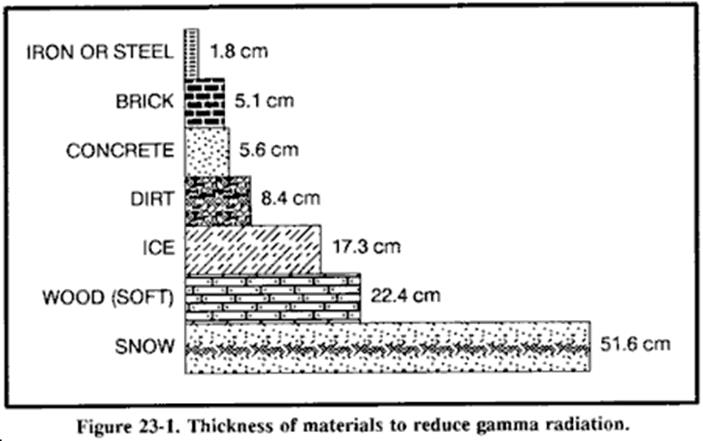
OK so what about shelter? Well, that’s one of those things that people just love to debate and go for the overkill solution. Most hard core peppers end up building versions that will ride out a near-miss from a surface burst. Unless you are within 75 miles of a hard target and expect a full up exchange, I’m not sure this is appropriate. Fallout tends to disperse in high concentrations close to the source, and decays exponentially with time. Most people can get by with less protection. The rough rule for exposure is keep the dosage to less than 125 rads in a month,  and it’s probably going to be less than 100 rads/hr for the initial rates. Doing some rough calculations says you need to reduce that by a factor of 16 to keep from getting ill.  That takes 4 half thicknesses of shielding (2^4=16), which can be obtained by about a foot of earth or 10 inches of brick or cement. A typical frame house will give roughly one half thickness, if you shelter in the innermost lower part OR the basement/crawl.

HVLYou need three additional half layers, the old CD books say pile up dirt but that’s impractical. My solution is: Sandbags. I have an 8″ brick walled above ground basement , so I only to add bags above to get the protection from the fallout coming from tree foliage and the roof.  When I first started thinking about this, I was focused on digging something but then realized that wasn’t practical. Not only would people think I’d totally lost it, but it’s not needed and would be a PITA to keep free of water, ventilate, and would be claustrophobia inducing to boot. Not to mention a tough thing to remove if I move.  Polypropylene bags come in white, OD, and beige and are 37 cents a pop in lots of 100. They store small, can be filled when needed, carried, and can be used to create a defensive fire position if that’s ever needed. I want the stuff I buy to serve multiple purposes, which these do.


Belated update on the 8 year storage results

I forgot to mention a few things when I posted the first round. In no particular order:

1. Powdered milk in the box = iffy. It looked sort of yellowed and smelled odd, it may have been OK but I’m recommending buying it an a vacuum sealed can. I need to break some of this out (I have that as well) and see if it is usable, I hate to blindly assume it’s OK.

2. Potato flakes in a box = fail. This was a 24 month in my pantry test, I made some up and noticed it was not white and tasted like used gym socks. Same thing as the milk, go with the #10 cans and test every few years. Maybe better at 60F, I dunno.

3. #10 cans= win. Even with a half-assed plastic box wrap in a really humid place, none of the cans showed any rust or degradation. I’ve since sealed the space, and ziplocked/dessicant bagged so I should be good for another 25.

Midrange planning and supplies update

I am finally getting caught up on the midrange planning and supply situation, that had been languishing due to work demands and other things. As you recall I had gone through the old stocks from 2005/6, and pitched anything that was not a classic “dry goods” item or known to have a very long shelf life. I focused on basic staples like flour, corn meal, salt, spices and extracts, oil, sugar, etc. I determined that these all keep fairly well if kept in Ziploc bags and plastic tubs, and at a reasonable temp. 5-6 years is about it, most of it passed the smell test but the cost just isn’t a factor. I filled a grocery cart for $220, if you had to do it from scratch (I had a few things on hand) maybe $300. I’m pleasantly surprised by the total volume of the supplies, they fit in a fairly small area and will last about 3 months or more depending on how lean I can go. The day to day stuff I have on hand (non-prep)  will last at least a month, then there’s a month or two of freeze dried. I’ll add a month of MREs, and the long-term grains which will put it past 6 months easy.

I’m looking around at it, and thinking how tough it would be to store a year’s worth. You could, but it gets expensive and takes up a lot of room. My idea is to have enough on hand to weather any immediate emergency, then start growing things if the situation seems like it will go longer than a few months.  6 months allows me time to get past winter and get plants going. Yeah it’d be nice to have more but I’m just not doing that.

Mid-term emergency planning

We’ve discussed short term planning and prep in a previous post, the next phase begins roughly 20-30 days after the event and lasts until you can achieve sustainability. Recall that the short-term will be covered by a relatively moderate amount of preparation and supplies, augmented by whatever you have on hand or can grab prior to the depletion of local stores. That will represent the last link to normal and familiar existence, after that runs out you will need to shift to a much more labor intensive routine. Most of us take advantage of prepared foods and many modern conveniences, none of which will exist. There are a number of categories to consider:

  • Heating
  • Power
  • Cooking
  • Water
  • Food
  • Sanitation
  • Self-defense
  • Shelter
  • Fuel
  • Transportation
  • Human interaction

It’s sort of a “OK I made it this far, now what?” scenario.  Up to that point, chances are it will seem like a camping trip or the aftermath of a hurricane; not a lot of work just consuming supplies. The next phase will need to last long enough to get things ramped up to allow existing on what you can grow and collect in and around your dwelling.  That’s the Day366 idea, maybe it’s Day183 but same principal. At some point, no matter how much stuff you hoard you will run out. That will be primarily food related items, the rest is less critical and beyond the scope of this blog. To a large extent, other things will become available as people move on (both figuratively and literally). For instance, say 5 months later you need some nails. The local Home Depot will probably have lots of them, you can’t eat nails and they are useless to looters.

I’m going to cover the last item of my list first, Human Interaction. This might be the most important one, since your survival could depend on who shows up at your place.

Human Interactions

There’s a new movie out called “American Blackout”, I don’t plan on watching it but the plot revolves around a cyber-attack on the power grid. It covers the first 10 days, but I’m not sure if it assumes the blackout lasts longer than that. This made me think (again) about how people would respond in a crisis, and how my planning would be affected.  Frankly, I have a very tough time imagining what others will do. We all tend to assume people will behave in a certain fashion, either like us, helpless incompetents, or as criminals.  That’s the sense I get visiting prep sites, maybe that’s correct but no idea, really. I’m going to try to be open-minded and think this one through.

Neighbors

These folks are, by virtue of proximity and familiarity, going to be the first to come a ‘knocking.  I expect them to be out and about and seeking help and information from the start of the crisis, it’s only natural but begs the question of how to respond.  On one hand, if outsiders cause trouble you may want to band together for protection. On the other, chances are they will only drain what limited resources you have and expect you to help even if you can’t. My position is to offer guidance, information (you may be the only link to the outside), and assistance defending against outsiders.  Say nothing about what you have, that will create a terrible problem later. I’d like to be able to function as Farmer Bob and feed the subdivision, but that’s not practical. So, the only reasonable path is to defer food requests and make them find it themselves. I could probably provide clean drinking water, assuming they bring it to me for filtering and treatment. I could also give them a few seeds, if they can plant and maintain a garden.  You have to force people to shift for themselves, otherwise they will do nothing and expect to be taken care of. Sound harsh, but there’s no other way to handle it.  It’s the old saying about teaching someone to fish rather than giving them one…

The exception to this is block defense, if strangers begin roaming and looting houses you may need to form a team to repel them. I suppose it would be like a tiny version of the Minutemen, those who own firearms respond to the call. That assumes your neighbors are not royally pissed off at you and/or are the ones doing the looting.

What I’d really like to do is organize the nearby homes, pool resources, and get cranking on the gardening/farming/wood cutting/improvising.  Whether or not I can convince people to follow that is a big question, but they’d have few options.   Beats me if this is feasible, or it breaks down and we end up in Mad Max mode after all.

Outsiders

This is the land of pure speculation. I’m not sure if too many outsiders would show up, given the difficulty of travel and resupply. If they did, I would stay quiet and wait until they left. If they caused trouble, warn then dispatch. I don’t see how you could tolerate any form of looting, that defeats the whole purpose of prepping and would cause you to lose everything you worked so hard to put in place.  ‘Nuff said there.  One complication would be cops and armed forces, if they started commandeering private property under some bullshit law it would put you in a real bind. I could just see the local doughnut eaters trying this, although I doubt it would be successful. If the armed forces do it, maybe better equipped but still facing resistance from heavily armed homeowners. Same approach, hide then attack if they persist.

Food

Learning from my storage experiments, here’s what I recommend as the food options:

  1. Freeze dried entrees, veggies, fruits. This stuff is reasonably priced, stores for up to 25 years, and has enough variety to prevent food monotony. How much is up to you, but I suggest at a minimum three meals a day per person for 3 months. This, added to the short term stock plus things I list later, should get you to the 6 month or beyond mark. http://www.beprepared.com is a good source of these items, I’ve been very happy with them.
  2. Freeze dried basics. You will want to augment the entrees with some staples, like potatoes, soy protein meat substitutes, powdered eggs, powdered milk/butter/sour cream/tomato paste, etc. These allow you add in simple sides and also make things like pasta sauce from long term stores. This will stretch out your entrée selection and use things like rice, beans, and pasta in normal dishes rather than prison camp fare.  What’s for breakfast? Beans. Lunch? Beans. Dinner? Get ready….RICE! Yay!  Need to avoid that trap. http://www.rainydayfoods.com/ is a good source for all this.
  3. Grocery Store items. You don’t need to buy everything in sealed cans, here’s a sample of what can be safely stored in Ziplock bags and boxes:
    1. Pasta.
    2. Rice
    3. Baking powder
    4. Yeast
    5. Salt
    6. Sugar
    7. Spices
    8. Cocoa
    9. Dry soup mix
    10. Potato flakes
    11. Canned meat. Note: this needs to be stored separately, rotated and checked. The cans do corrode and the result is a disaster.
  4. Grains and legumes. Sold as a kit by BePrepared, contains a years supply of misc grains. Highly recommended, but note requires a grain mill for the wheat and oats.
  5. Oils. I’m still working on this, but so far the leading candidate is coconut oil. It’s almost fully saturated, is a solid below 75 F, and is said to keep for 6+ years if kept cool, dark, and unopened.  Plain corn oil is OK if you check it, but this is a work in progress.  BTW you MUST have some kind of fats and oils in your diet, plan on looking like the Olsen twins without it.
  6. Powdered drink mix, coffee.  This falls under the monotony rule, it is said that drinking just plain water leads to dehydration, esp. with kids.  Packets and jars of Koolaid and chocolate milk store well and are easy to make.

Heating and Cooking

Really the same thing, you probably will be using the same item as a heat source and for cooking. The best approach is a propane burner, this can be run indoors with no smoke. Downside is the need to stockpile gas, but some quick ciphering leads you to about 8-10 15 lb cylinders as a minimum. That’s not bad at all, and highly recommended. Using a Coleman camp oven on top the burner gives you a small volume stove.

Alternately, you can purchase a cheap wood stove and pop for the Lehman’s Amish oven. This is a lot more hassle, you have to run a chimney, cut and season wood, and will create a giant signal that says “go here to pillage”.  It’s totally non-stealthy, and really belongs in the Day366 section but thought I’d mention it.

Stay tuned for more when I get motivated to finish this post….
Solar storms, the electric grid, and nuclear fuel storage

Add this one to the natural disaster category. I’ve mentioned EMP, and stated it’s unlikely as a reason for the grid to go down but there’s actually a far more plausible scenario. If the sun spits out a giant flare, it can create a large EMP-like effect on long electrical conductors. There’s no fast rise time pulse that frappes solid state devices, but it generates similar magnitude low frequency currents. These can cause core saturation in the large HV utlity transformers, which causes them to overheat and self-destruct. This has actually happened in recent memory, and caused some major damage and outages even with the moderate levels of solar flux seen in those events.

I say moderate because there are truly massive flares that occur every 500 years or so, with lesser ones every 100. The biggest on record was the Carrington Event in 1859, this caused telegraph lines to fail and catch on fire. Another one occurred in 1921, with less magnitude but with many power system failures. Utilities are installing neutral resistors to stop the transformer failures, but in a large event the transmission lines may fail. And, having large sections of the grid down will tend to bring all the local generators down with it, since they are all interconnected. The system isn’t designed to operate in “island” mode, there’s a lot of load sharing and synchronization between all the elements. There have been cases of a single HV line going down, and taking large areas off line for days (even with no damage). It takes that long to get everything reconnected. If multiple areas are off or at partial capacity, it may take weeks or longer to get power back. Turning off power for weeks would be the worst thing to ever occur in this country, things would just grind to a stop. Think about the lack of food storage, working hospitals, fuel and water pumping, banking/finance, lighting, etc. It wouldn’t even have to be for that long, many people would be in trouble within hours. That would be bad enough, but it gets better…

It’s a little known fact that all nuclear power plants store depleted fuel rod assemblies on site. These assemblies are highly radioactive and give off lots of heat, so the utilities store them in concrete pools filled with water.  The water is needed for shielding, and most importantly to prevent the rods from getting so hot they melt and burn. The pools are packed well past capacity due to the cancelling of the Yucca storage facility, so a loss of water pumping would cause the water to boil off in a matter of days. In theory each plant has a way to add water via diesel pumps, but if this isn’t done you get a radiation leak from the meltdown in the pool. Interestingly, the storage pools are not covered with a concrete dome, they are usually metal roofed commercial buildings. So, a fire would cause the facility to vent radioactive smoke in a long plume downwind of the site.   Sort of like Chernobyl. Depending on all the variables like wind speed, direction, how much fuel was stored, how long the operator was able to add water, you could get a really horrible situation repeated N times across the country.

I can’t find out much about how likely this is, there’s very little information about how the NRC plans to add water in the event of a grid collapse. They seem to spend all their energy downplaying the likelihood of the grid shutting off, while not mentioning how to avoid it or the outcome.  So add Gieger counters, dosimeters, and sandbags to the planning list.  If you get stuck in an area downwind of a nuke site, things may be hot so it’s best to have some sort of shelter.  

I’m mostly pondering the grid outage, not so much the poly Cherynobyl. If you stop and think, it seems like something that could happen due to the lack of backups. But, maybe I’m overly pessimistic. As I’ve said, people are pretty resourceful but it could be a while to recover from that. It supports the idea of having a 2-4 week reserve, and some electric backup.

Results for 8 year storage of various items


I just checked on some stuff I had stored way back in 2005, some of it was supposed to be rotated out at 4 years but some didn’t have a hard use by date. I haven’t gotten to opening some individual containers and checking, just visuals and observations. So far one negative result and the rest positive, but this is all new to me. Keep in mind this was a pack and forget, and I suspect most people are going to be lax on checking up on the cache. Here’s the summary:

Gasoline

Win. This was the big surprise, put 10 gallons in my truck and it ran fine. No discernible difference between that and pump gas. Usually stale gas gets dark yellow, and reeks like old paint. This was a little yellower than fresh, but smelled the same. The trick was to store it in plastic, and keep it cool. I figured it would be dead, but no.

Canned goods aka No Soup For You

Fail. Canned soup rusted from the inside out, and weeped on all the other cans, rusting them too. It was either the tomato or the chicken noodle, I guess the salt or acid affected the can coating. Based on that, I recommend no canned soup or any canned goods with liquids go into the supply. Canned vegetable and soups are all readily available as dry mixes or dehydrated, there’s really no point in cans. Jars probably have the same problem due to the metal lids. I might make exceptions for canned meats, but I am not sure about the specifics. You’ll have to wait another 5 years for that….

Dry goods

Win. Everything looked great, zero issues on inspection. No mold/weevils/splotching/rusty cans etc. The sugar was still granular, no caking (fully expected a solid concrete like mass in the bag).

Vegetable oil

Win, to my eye. Still nice and clear, have yet to crack one open and sniff. I may try to send a sample to a lab if it’s not too spendy. Supposedly when ooil goes bad it gets rancid and smelly, and tastes like shit. No way I will actually eat it.

Peanut butter

Win, conditional. Same as the oil, looked fabulous. Will sniff and then send for a test.

Storage conditions

My storage area is cool, but not really that dry. I put everything in big storage bins, then used big ziplocks inside that for most things. I have some cans that were boxed, those got bagged and taped but I think I need a better seal. I recommend ziplocking EVERYTHING, and tossing in a dessicant packet. That way you know for sure it’s sealed.