Converting the Jetboil to propane cylinders

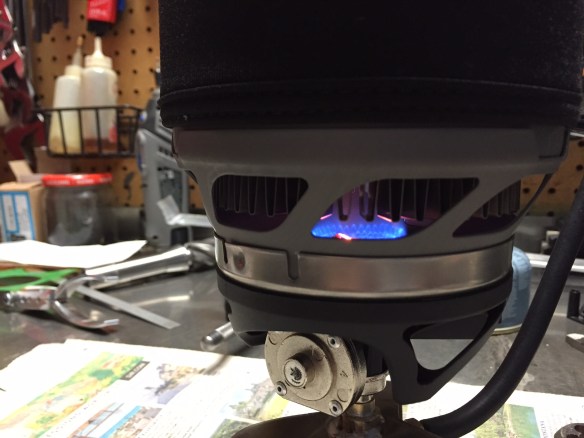
I bought a Jetboil Minimo  to have a compact water boiler, and to work with the freeze dried pouches in case of a short-term event. It’s also handy if we need to evacuate, although I can’t see why we would need to.  The Minimo is a great product, it’s rare for me to find something that isn’t lacking in some way but this is one of them. Zero complaints, but of course I wanted to have the option to run a standard propane cylinder vs the expensive canisters. There are a few adaptors out there, but they don’t work with the Jetboil base and seem dodgy. Web searching turned up the key point that the gas threads are 7/16-28, which is of course not standard. But, a common radio connector IS, so I found one on a old cable. Don’t know the brand, but it’s a TNC female for RG-58 with a crimp sleeve. This fit the gas port PERFECTLY (see below).

I used an 1/8 pin punch to press out the Teflon sleeve, you will need to remove it to have a port for the gas. It presses out from the end opposite the threads. One that’s done, it can be attached directly to a 1/8 ID rubber hose via the handy barb if you can a straight on path.  Since I wanted a low profile, I used an 1/8 NPT F-F right angle fitting, drilled out on one end to accept the TNC. That gets filed to clean the plating off, and soldered in. The right angle is then soldered to a piece of sheet metal, which is artfully bent to fit the plastic base.
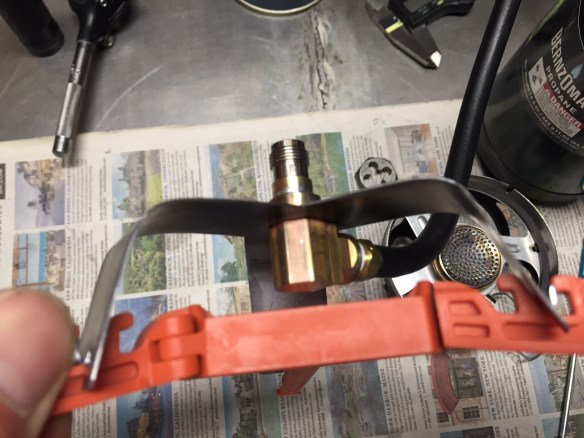
 

sideI used an 1/8 NPT hose barb to fit the hose (more on that later).

Top view

topI used a lathe to turn the TNC body to 0.430, this fit the right angle but it looks like it would fit with a slightly larger drill.

Show time

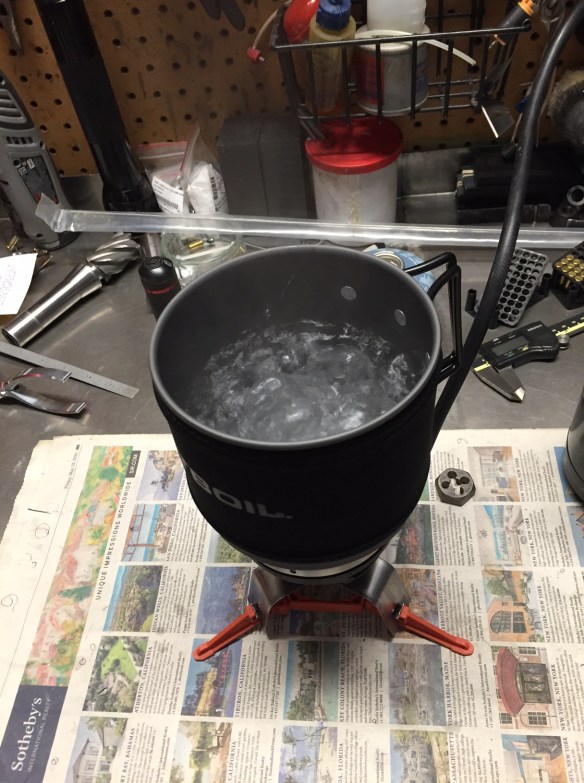
Once I got it all together, I cranked it up and got a gas leak at the barb threads. Added thread tape, and YEAH BABY flame.  Added a pot of water, and noticed it took a while to boil, and had an orange flame at the tip. OK, so maybe a jet change? I turned up to full, and it went “plop” and winked out. No gas flow. I used compressed air and blew the jet out backwards without dismantling it fully, and back in business.  I think there was swarf in the hose, but after this it worked great (stoichiometric flame and rapid heating). No difference between propane and the butane/propane mix, at room temp. In base camp Everest, probably not the case but that’s not a concern for me.

First test (with swarf). You can see the Bernzomatic extension hose…
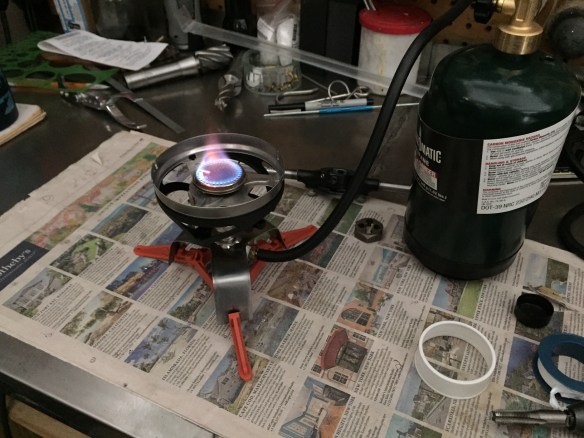
setup

Second test (swarf removed)

blueflame

Houston, we have a go for boil

boil

The hose is a Bernzomatic extension kit, it’s 14 bucks at Home Depot and was exactly what I needed for this. Just whack the hose at the point you want, and attach to the barb. Saved me a ton of effort fabbing a custom part from a hand torch.

You may notice 22 LR reloading stuff in the pic, that’s a whole ‘nother topic.  Basically I’m trying to make a custom quiet pest round, using unfired Aguila Colibri brass and loading shotgun powder. I either get a *%$@# cannon blast noise or a pathetic droopy trajectory.  Yes, I have tried ALL the available subsonics and they are either way too loud or Airsoft realm.  I’ll figure it out, eventually.  Will involve Red Dot or Blue dot powder….
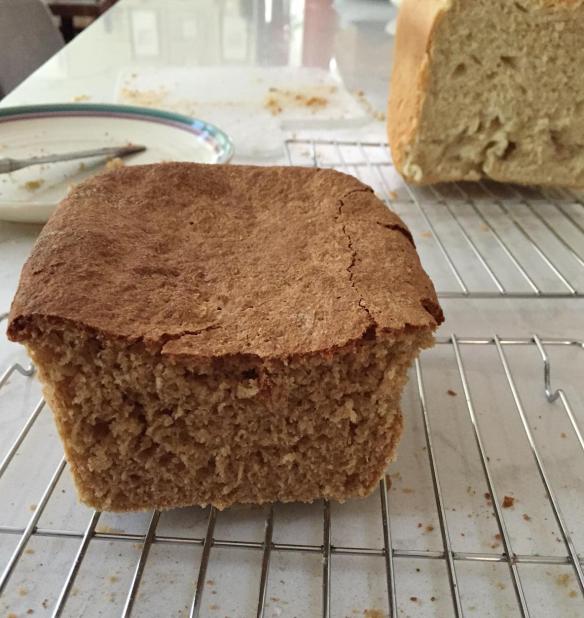
 

Wheat Bread Victory

Hooray, I finally made a loaf of 100% wheat bread that was tasty and everyone chowed down on. The trick was (as I mentioned earlier) to use whole berries, grind them as fine as the machine will go, use 50% more water than recipes call for, and bake at 400 vs 350.

Exhibit A

img_2145

Nice crumb, hard crust, not dense. The white load behind it is from a bread machine, it’s like candy and the family eats it up as soon as it comes out of the machine.

The next big thing will be to try sourdough, in a crisis yeast will not be available so it’s a must. It is said the sourdough yeast works a lot better in whole wheat than the packaged variety, and you can make a firmer loaf that self supports (boule). I have the starter direction, will give that a whirl over the next few weeks.

Wheat Pancakes

I had a cup of flour left over from bread making, so I made whole wheat pancakes.  They were very good, my wife and son loved them but D2 wee’d on them. Figures, she hates anything whole grain.  They look and prepare the same as Bisquick versions, they have a little more of a wheat flavor but otherwise taste great. I didn’t know how the hard wheat would work in self-rising goods, turns out pretty well. I have the soft wheat berries but haven’t done anything with it, I’m not planning on that sort of refinement in my wheat farming.

Stay tuned for Operation Sourdough, that’s in the pipeline.


Breakfast in America (freeze dried)

I finally got around to trying powdered eggs. I’ve been meaning to do this for a long time, and got a bit of time to experiment.  I’d always heard powdered eggs were bad, and I see why. To start, I bought a #10 can of Scrambled Egg Mix from BePrepared. I followed the instructions, made a small batch that looked great but tasted nasty. I can’t really say what specifically makes it bad, maybe salt but it’s just this weird unnatural flavor combined with a rubbery texture. I tried using less water to combat the latter, and it improved things but only marginally. It went from vile to “no seconds for me, thanks”.  It was like a dry Egg McMuffin egg portion, puck like but oddly far more edible. You could make a sandwich out of it and it would be OK.

The Contenders

img_2150

I read some Amazon reviews of powdered eggs, and the consensus was “Ovaeasy” is the best. Got a small packet of those, and yes we have a winner.  They are very close to real eggs in taste and texture, and pretty good to eat. I fed some to my wife, who said “I’d eat them if I was starving” which means they were OK. I finished the whole portion, which I could not do with the other product.  Glad I didn’t buy a lot of those!

Speaking of breakfast, I also tried the Mountain Home Bacon and Eggs in a pouch. That was fair, I ate it but it’s not quite as good as Ovaeasy. It’s way easier to prepare, no dishes or fooling with whisks and pans.

Potatopalooza

It’s been a busy summer with regards to spuds, running multiple growing/storing experiments at two sites. I’ve been trying to do a number of things with them:

  • Establish a continuous supply of seed potatoes
  • Have spare potatoes on hand to consume
  • Figure out how best to store them in all seasons
  • Get them established from true seed
  • Find the best grow media and weather strategies

True Seed

I bought 200 seeds online last spring, and have had decent luck getting them to grow. Maybe half germinate, then maybe 75% make it to the mature plant stage. I’ve found the plants to grow very slowly in early spring, then take off and get exceedingly leggy like tomato vines. These vines grow well all summer until the really hot weather arrives, then they die back.  They seem to do well in the partial shade, sitting on the cool cement pad. Any more sun or being elevated kills them.  They do make 1″ tubers, I have groups of these drying in the root cellar and also dormant in pots. This will be the first crop of TPS spuds, I’m hoping to get them through the winter for early spring planting. These are whites, versus the reds I’ve grown so far.  I’m really hoping to get a spring crop out of these, if they will store. I may need to fridge them in dirt.

Grocery Store clones

These have done the best so far. I started with a handful of sprouting reds, planting them in crap soil (mostly clay)  as a lark. This crop came up last fall, went dormant, then came up again strong in late spring. I learned a few things from that:

  • Mulch the soil. Yeah I read this a million times, but it really is vital. You have to have loose soil with plenty of organic material for the tuber to grow into. Regular dirt works but doesn’t give them enough room to take off.
  • Mounding is overrated. I haven’t been able to do the potato tower thing at all, I get no tubers above where they first really grew foliage. Maybe it’s the pots, I have a new crop coming up now in good ‘ol black humus and we will see how that goes. I’ll mound those up and see what happens.
  • Dug potatoes only store in the cold. I had a couple of batches in the 68 degree cellar, the only lasted 5-6 weeks before they sprouted. These were dug in late July, versus some I had that went 4-5 months outside in pots during the winter. I kinda knew this but tried to cheat nature. They did, however, do quite well as seed potatoes and are shooting up in the new patch.
  • Hot weather is nearly as deadly as cold.  The potted plants hate the hot, I got a lot of die back in the summer vs the spring/fall. The ground plants handled it much better, which stands to reason but it’s interesting.
  • Reds are more robust than whites. Must be the climate, but so far they have been way better. I have different varieties of whites and they are all lacking.
  • Homegrown taste way better than store bought.  I have a hard time eating anything but my own now, there’s just no comparison.  This is a great excuse to grow potatoes, the ends justifies the small effort involved. I made mashed and roasted from the extra reds I got in July, OMG they were good.

The Big Gas Crisis of ’16

We are in the middle of a gasoline shortage, caused by a POL pipeline leak. It had to shut down for repairs, which causes a hiccup in the supply but should not cause a total lack of delivery. Turns out the news media started running stories about how prices were going up, which caused everyone to rush out and fill up, which then led to stations running out and so on.

Now there are very few places in the state that still have fuel, and it’s a crisis.  As I posted long ago, I store 10 gallons of gasoline in sealed  jerry cans so we are OK for a few weeks, plus I have 50 gallons in my pickup that I can drain out if needed.  This was another wake up call, I didn’t anticipate the need for that much fuel to be stored. I figured if something happened I’d just need enough for a few car trips and then the generator for battery bank charging.  Based on this event, I think I need at least 25 gallons stored plus truck tanks for 55-60 total.

It’s not the supply itself, rather the panic buying that causes the issue. I can see how any little disruption in fuel/food/supplies will get amplified by the media, so it’s best to have plenty on hand of whatever you may need. It will be interesting to see how long this lasts, in a actual crisis things would take forever to recover due to the lack of backups and people’s behavior. I can totally see rioting happening, it probably wouldn’t take much esp. if food was involved. Case in point: 22 LR ammo. Back in 2012 there was some talk of tightening up gun laws, which somehow led to  a run on 22 ammo. It took over a year for the supply to get to above zero, but in 2016 we are still on allocation with high prices in place. Unbelievably, people are STILL trying to amass 10-20K rounds which is just killing the supply chain.


What amount of prepping is enough?

I ask myself this, especially as I’m getting down to crossing off the last handful of items on my big list.  On one hand, it is very nice to have certain things on hand for the occasional ice/heavy snow storm or summer storm power loss. On the other, some things can seem like a waste viewed in terms of the probability of occurrence. I’ve tried to only get things that have a dual use, but isn’t always the case. For example, I bought a small wood burning stove with sidesaddle water heater. If I ever buy some undeveloped land, that can get installed in a cabin. But freeze dried food, that will never get used.

I suppose the goal is to keep certain critical items on hand for a short time frame, but not go hog-wild. MREs and firearms are in that latter category, expensive and not required but seem like a major preoccupation with some people). I’ll add things like gas masks (what’s up with that?), bug out bags, night vision gear, camo, etc. It’s as if this is some paramilitary adventure, versus long-term camping.

Anyway, I am satisfied with what I have and don’t feel the need to do much else. I still need to get a big first aid kit, some bleach powder, protective gear for contagion, and a laundry plunger. That’s it, everything else I have. Frankly, if anything does happen plans will have to be formulated on the fly anyway. I just need the basics . I suppose this is the difference between being OCD/hoarder and prepared, is it enough or irrational acquisition?


Spring update

It’s been a busy spring, not much time to post and just working on getting all the plants pruned/in/maintained.  I have two gardens, one at work and one at work so they’ve kept me hopping. I’m still on the path of planting all the various crops I’d need, and then getting them to yield and produce seed for the next season. And figuring out how to store and process them.

Here’s the highlights:

Berries

I have blueberries, raspberries, and blackberries all in big pots. This is working well so far,  the only difficulties are keeping them watered in the summer and protecting them from pests. Everything else is well-documented on the web, the need for fertilizer and pruning, and various diseases (all which I’ve encountered).  The pests are a big issue, I had to build a wood frame with plastic bird mesh to keep the catbirds out. They take every single mature blue and blackberry, but don’t seem to care about raspberries. That worked for the birds, but I had squirrels wiggle under the mesh and trample one of plant’s canes.  I added a 48″ fence, but they raised that up and did it again, unbelievably. So, they had to go the hard way which I’ll leave to the imagination.  The far left plant has yellow leaves due to the broken canes, grrrrrr…If you look closely, you can make out the black mesh but it’s nearly invisible.

Berrypatch

Since using fruit fertilizer, all the plants have borne a heavy crop of berries and I’ve been able to eat them every day as well as freeze enough for cobblers. It is very satisfying, and I’d say if I had room for nothing else I’d grow berries.

Potatoes

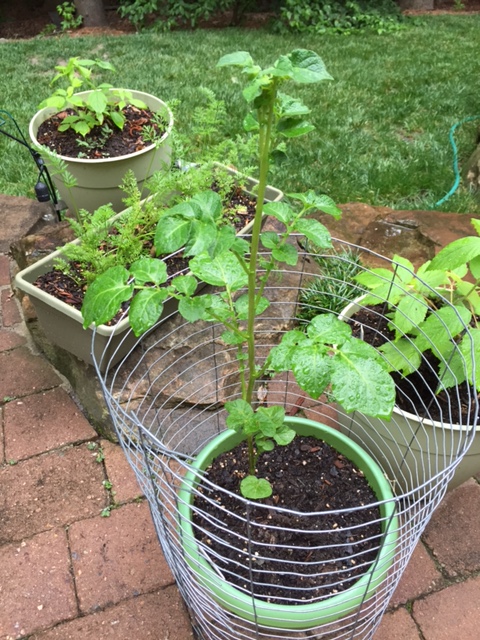
Recall I had a few fall plants growing from seed, those all croaked BUT one produced a 1″ diameter tuber than ended up sprouting. This dude is doing well in the wet, cool weather:

IMG_1982

It’s a lot leggier than the reds I have at work, but we will see how it yields. I started it in 3″ of soil, then added the rest as it grew. I will probably just see how this one fares before going nuts with the potato tower idea.   Work spuds are rocking, the 8 I planted overwintered and came up in April just fine. In fact they are everywhere, so with luck they yield and I can try to finally save ’em in a mini fridge for fall. I plan on packing them in moist dirt at 40 degrees, that seemed to work great last winter.

Garlic

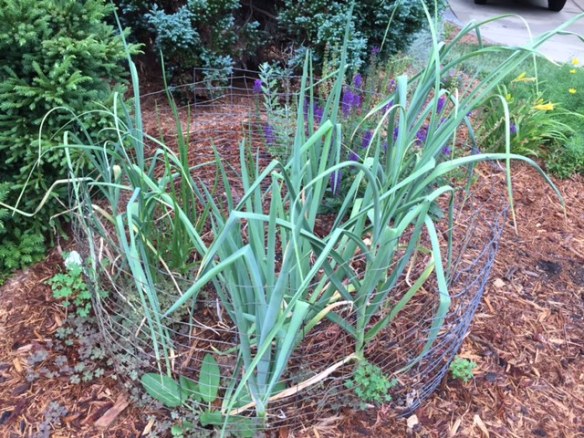
Last summer I had some grocery store garlic that was sprouting, so into the dirt they went. Big hit, they came right up and overwintered and are huge. I’m anxious to see how the bulbs form, it can be hit or miss but they sure look healthy. There’s bunching onions and Valencias mixed in, those all did well too.  The fence is to keep out the rabbits, which ATE THE ONIONS.

Garlic

Seed production

The chives finally bloomed (beautiful purple flowers), I got a small quantity of seed which I’ll fridge for the fall. Oregano and celery are forming, so those ought to be ready soon. I think that was everything I planted, it all went to seed but took 2 years in some cases.

Corn

I have 32 Tophat sweet corn plants at work, I got them in early this year and they are about 2 1/2 feet tall. I’m hoping they will produce fully formed ears, I hit them with shots of nitrogen at sowing and again recently. That seems to the be the key, it definitely made the wheat head out.


Cash in an emergency

A few weeks ago, we were out and about and stopped by an Arby’s to pick up food for a sick relative. When we went to order, the cashier said their POS (point of sale) terminal modems were down and they could only accept cash.  This rarely happens, but luckily we had sufficient cash on hand to pay. It was interesting to see how many people didn’t, I’d say maybe 1 out of 4 or less had even 10-15 dollars on hand. It was a stream of people in, then out when they found out it was cash-only.

I had added paper money to my emergency check list, but never had time to get to the bank to make a withdrawal.  I finally did this, it’s something that you would definitely need even in a very short duration power loss as with windstorms or ice.  I forgot how much people have moved to electronic payments, if for some reason communications are interrupted you have NO way to pay for ANYTHING.  If there’s some sort of major outage for any reason, including a coordinated attack on comms or the electric grid, it would be catastrophic solely due to the lack of commerce let alone anything else. It’s just another thing that you don’t want to have zero reserves of.   I’m sure business would be able to conduct local transactions manually, but if you don’t have money there’s no way to make withdrawals. The banks wouldn’t be able to debit accounts without access to databases, nor would B2B work as that is all electronic. There would be a window where things would work more or less normally, but when restocking was needed it would get interesting.


Impeller pressed sunflower oil, DIY

Background

With the recent cold and rainy weather, I finally had time to try out making my own sunflower oil. Using the press I built (see the older post on sorghum syrup), I followed the instructions on this site:  http://journeytoforever.org/biofuel_library/oilpress.html

I used oilseed purchased on Amazon, spendy but I got a load of seed for experiments and for fridge saving over a few years. There’s enough to sow a large plot with enough plants to generate a years supply of oil. My biggest issue was pests, mostly finches but also deer and squirrels. Once you have a large enough plot, there’s not enough pests to get the whole thing, assuming you put up a fence to keep the 4-legged critters out. Birds will eat as much immature seed as they possibly can, they are voracious pests so plan on loss unless you can add plastic mesh overhead.

The process

Starting with cleaned black oilseed, use a kitchen blender to shred the whole seeds until it turns into coarse flour. You can only do about a half quart at a time, once the flour forms the whole seeds stop getting to the blade.  Heat the flour up in the oven until it gets to about 150 F, this allows the oil to become less viscous and flow out of the slug inside the press. Don’t be afraid of overheating it, it cools down quickly and you really need a hot press to get the oil out. It will help to preheat the press itself, it will keep the slug warm. You will also want to add heat to the press with a heat gun, to keep it from cooling off.

Load the press full, then compress it by hand to pack as much in as you can. The sleeve will compress 3-4 times in volume, so expect that. You will also need a very large force, I used a 2 ton hydraulic press for the pressure. This was just adequate, the press was binding and at the limit of what I felt comfortable with. Still, it worked very well but could use refinement.

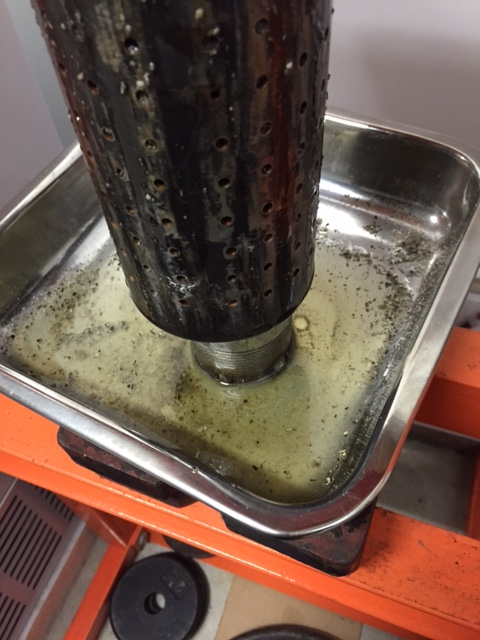
Towards the end of the pressing

I initially got nothing out of the slug, I was thinking “this is a bust” but it finally began flowing out the ports. It took a while, applying heat, cranking the press, and letting it rest. It eventually compacted to an end stage where no additional oil flowed, that’s time to collect and filter the oil.

IMG_1869

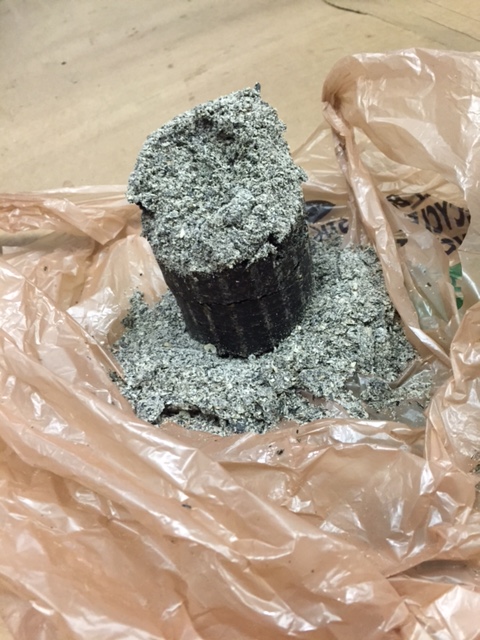
The spent slug (turd to some LOL)

Looks like wood ash, but it’s just the flour. It is as hard as a rock, and requires a large screwdriver and mallet to break free from the press sleeve. Lots of people complain about this, the little screw presses are really tough to clean from what I hear. I’m also not sure they generate enough force to clear all the oil from the “cake”.

IMG_1871

Collecting and filtering

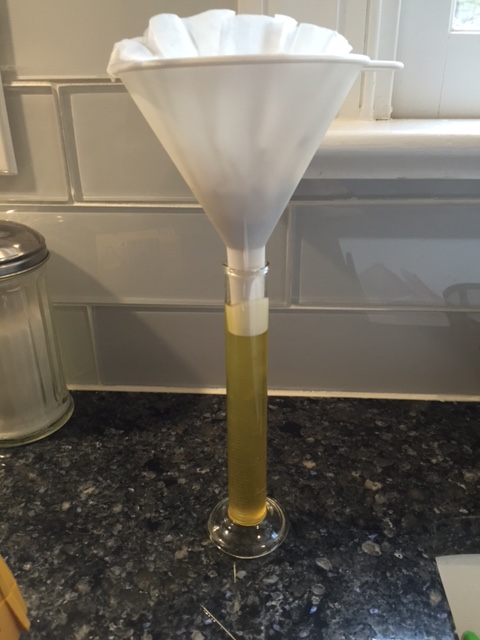
I heated the pan, and poured the hot oil into a coffee filter lined funnel on top of a 25 mL graduated cylinder. I wanted to accurately measure the yield, and I got just about 50 mL from a quart of loose seed (not flour). This seems to be about the right yield, looking at reference site’s numbers. It looks great, nice and clear but took overnight to clear the last of the oil through the paper filter. Coffee filter are around 15 microns, this is too small for a gravity filter and especially oil. I will get a 25 micron mesh and see how that goes, I don’t recommend paper for an oil filter unless you pressurize. Next steps are to fry some stuff in the oil, it’s in the fridge waiting for the test. Supposedly oil will turn rancid quickly at room temps, so I’m being cautious.

IMG_1872


Winter time harvest

Wheat Bread

I finally got around to grinding the wheat I grew, then making bread. I used an Oster bread maker, it worked quite well but still needs improvement. I didn’t know about the need to use less yeast and let the dough rise for 3 hours, that avoids the collapsed top common to the heavy wheat flour.  I also skipped the multiple knead/punch/rise steps, I found it’s better to just do a single 12 minute knead and then a slow rise. It makes the loaf a lot lighter. Here’s the result:

IMG_1822

This was a 1.5 lb loaf, as you can see it was pretty decent in terms of the rise and the density although I kick myself for not letting it rise to the top of the pan. I was worried it would collapse, but I don’t think that would have happened.  It tastes great, it was the Oster manual recipe and no complaints about that.  Pretty cool, I went from a handful of seed to actual bread.  I’m out of homegrown wheat, so I am using the Emergency Essentials cans to continue the breadmaking process improvements. I hope to eventually make first class bakery style bread, but this is perfectly acceptable for survival.

Potatoes

Recall the red new potatoes I put in the planter? Well, those grew like mad until Christmas and then died. They did make a fair size crop of new tubers, I was so excited to see the little guys buried in the dirt:

IMG_1819

I boiled these and we ate some with butter and thyme, then the rest fried. They had a very delicate flavor, I’m not a big potato guy but they were as good as the store. Win there too.

Things have settled down now that cold weather is here, not much to do outside just waiting for the last heavy freezes to pass to plant again.  I’ll probably try the wheat bread again, and see how much better I can make it.