Now that I have a lot of my mid term plans and supplies done, I’m looking at long term, mobile operations, and “second-order/Black Swan” scenarios. By that I mean things that can happen, but are not as likely and not worthy of attention until everything else is done. One of these is a nuclear exchange or a long term loss of grid power (nuclear fuel fires). For that, I still need everything I already talked about but also a way to detect gamma/beta radiation and some type of fallout shelter.
Detectors
There are three types of radiation detectors on the market; new lab grade survey meters, low cost Geiger counters, and government surplus. The problem with the first is expense, to cover the range expected in a crisis would take thousands of dollars. You can’t get a decent instrument that will cover 1 mR to 500 R/hr, the closest I found was Ludlum’s in Texas but they are not really customer focused and you’d need add ons to get the range. Plus it’s expensive.
Amazon/Ebay stuff is usually gimmicky/low cost with a low max rate, usually less than 0.1 R/hr which is OK for things like high school science lab but not for even low levels of fallout. You have no way to know whether or not you’re getting 1 R/hr or a 1000, which is the difference between living and dying.
And then there’s CD surplus. It seems there are large stocks of 60s/70s Civil Defense meters being released into the surplus channels, so one can pick up bargains. BUT, these things have been sitting around for 50+ years with a lot of it inoperable. I was lucky to find this guy:
He has repaired and checked CD-700/715 meters and dosimeters, plus I scored a complete NOS shelter kit:
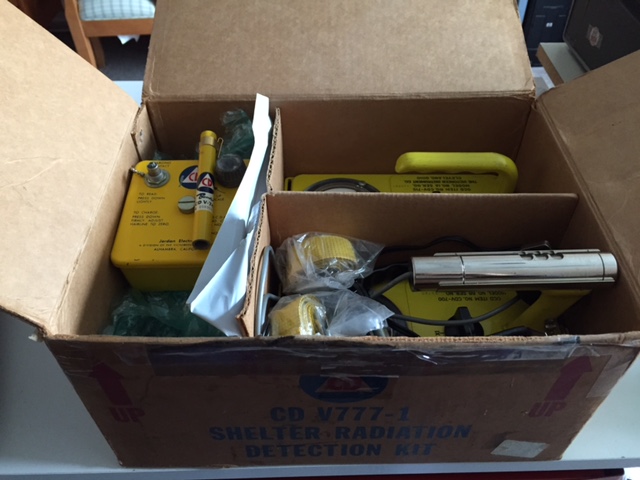 This covers all bases, from low level to lethally hot AND has the dosimeters. Price was right, too. You need a check source, you can use uranium ore or Peerless lantern mantles which are commonly available.
OK so what about shelter? Well, that’s one of those things that people just love to debate and go for the overkill solution. Most hard core peppers end up building versions that will ride out a near-miss from a surface burst. Unless you are within 75 miles of a hard target and expect a full up exchange, I’m not sure this is appropriate. Fallout tends to disperse in high concentrations close to the source, and decays exponentially with time. Most people can get by with less protection. The rough rule for exposure is keep the dosage to less than 125 rads in a month, and it’s probably going to be less than 100 rads/hr for the initial rates. Doing some rough calculations says you need to reduce that by a factor of 16 to keep from getting ill. That takes 4 half thicknesses of shielding (2^4=16), which can be obtained by about a foot of earth or 10 inches of brick or cement. A typical frame house will give roughly one half thickness, if you shelter in the innermost lower part OR the basement/crawl.
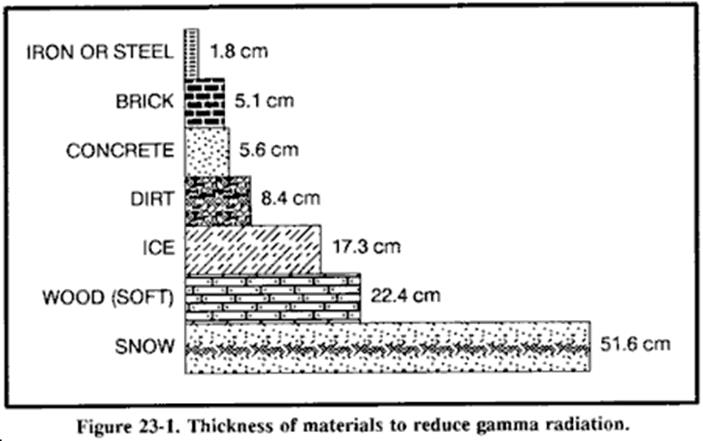 You need three additional half layers, the old CD books say pile up dirt but that’s impractical. My solution is: Sandbags. I have an 8″ brick walled above ground basement , so I only to add bags above to get the protection from the fallout coming from tree foliage and the roof. When I first started thinking about this, I was focused on digging something but then realized that wasn’t practical. Not only would people think I’d totally lost it, but it’s not needed and would be a PITA to keep free of water, ventilate, and would be claustrophobia inducing to boot. Not to mention a tough thing to remove if I move. Polypropylene bags come in white, OD, and beige and are 37 cents a pop in lots of 100. They store small, can be filled when needed, carried, and can be used to create a defensive fire position if that’s ever needed. I want the stuff I buy to serve multiple purposes, which these do.
 Day366Blog