Geiger counters and Black Swan events

Now that I have a lot of my mid term plans and supplies done, I’m looking at long term, mobile operations, and “second-order/Black Swan” scenarios.  By that I mean things that can happen, but are not as likely and not worthy of attention until everything else is done.   One of these is a nuclear exchange or a long term loss of grid power (nuclear fuel fires). For that, I still need everything I already talked about but also a way to detect gamma/beta radiation and some type of fallout shelter.

Detectors

There are three types of radiation detectors on the market; new lab grade survey meters, low cost Geiger counters, and government surplus. The problem with the first is expense, to cover the range expected in a crisis would take thousands of dollars. You can’t get a decent instrument that will cover 1 mR to 500 R/hr, the closest I found was Ludlum’s in Texas but they are not really customer focused and you’d need add ons to get the range. Plus it’s expensive.

Amazon/Ebay stuff is usually gimmicky/low cost with a low max rate, usually less than 0.1 R/hr which is OK for things like high school science lab but not for even low levels of fallout. You have no way to know whether or not you’re getting 1 R/hr or a 1000, which is the difference between living and dying.

And then there’s CD surplus. It seems there are large stocks of 60s/70s Civil Defense meters being released into the surplus channels, so one can pick up bargains. BUT, these things have been sitting around for 50+ years with a lot of it inoperable. I was lucky to find this guy:

http://www.uraniumrocks.com/

He has repaired and checked CD-700/715 meters and dosimeters, plus I scored a complete NOS shelter kit:
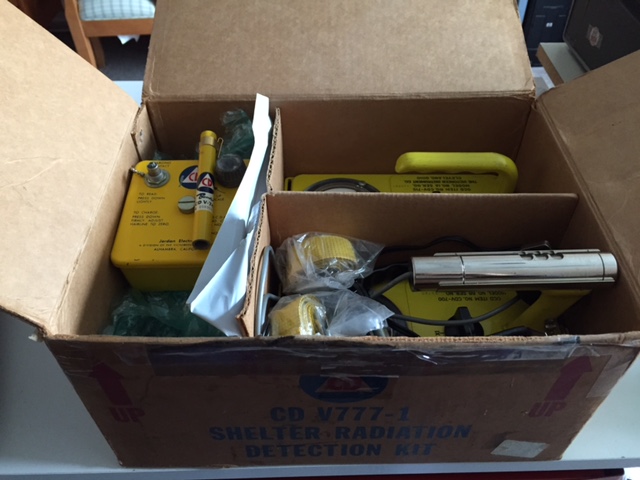
IMG_1396This covers all bases, from low level to lethally hot AND has the dosimeters. Price was right, too. You need a check source, you can use uranium ore or Peerless lantern mantles which are commonly available.


OK so what about shelter? Well, that’s one of those things that people just love to debate and go for the overkill solution. Most hard core peppers end up building versions that will ride out a near-miss from a surface burst. Unless you are within 75 miles of a hard target and expect a full up exchange, I’m not sure this is appropriate. Fallout tends to disperse in high concentrations close to the source, and decays exponentially with time. Most people can get by with less protection. The rough rule for exposure is keep the dosage to less than 125 rads in a month,  and it’s probably going to be less than 100 rads/hr for the initial rates. Doing some rough calculations says you need to reduce that by a factor of 16 to keep from getting ill.  That takes 4 half thicknesses of shielding (2^4=16), which can be obtained by about a foot of earth or 10 inches of brick or cement. A typical frame house will give roughly one half thickness, if you shelter in the innermost lower part OR the basement/crawl.
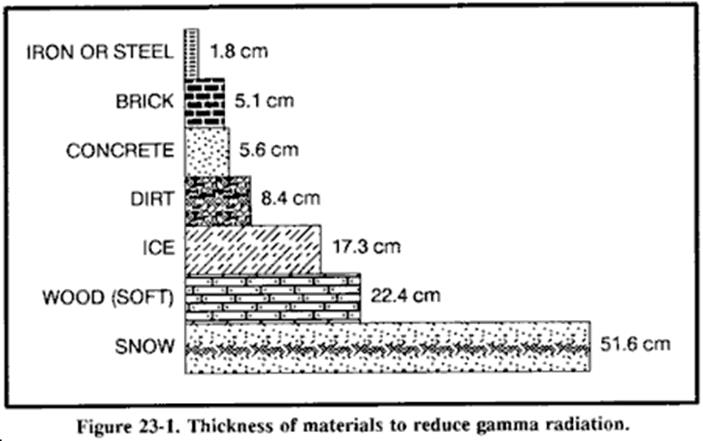
HVLYou need three additional half layers, the old CD books say pile up dirt but that’s impractical. My solution is: Sandbags. I have an 8″ brick walled above ground basement , so I only to add bags above to get the protection from the fallout coming from tree foliage and the roof.  When I first started thinking about this, I was focused on digging something but then realized that wasn’t practical. Not only would people think I’d totally lost it, but it’s not needed and would be a PITA to keep free of water, ventilate, and would be claustrophobia inducing to boot. Not to mention a tough thing to remove if I move.  Polypropylene bags come in white, OD, and beige and are 37 cents a pop in lots of 100. They store small, can be filled when needed, carried, and can be used to create a defensive fire position if that’s ever needed. I want the stuff I buy to serve multiple purposes, which these do.


Deflating the Rational Man theory; how likely are man-made crises?


I mentioned the Rational Man theory long ago, this is the idea that a person (or a leader of a country) will always act in a rational manner and to maximize their own safety and self-interests.  Preparing for a crisis/emergency usually involves assessing the relative likelihood of that event occurring, so we need to know that. There a number of potential crises that hinge upon the actions of leaders, such as EMP attacks, limited war, bioweapons, state sponsored terrorism.  Most people discount the probability of these because there’s no real point to the action. We know the attacker will almost surely suffer far greater losses than the victim, and will probably cease to exist in the aftermath.

However, history is full of what seem now to be senseless acts, mostly carried out by dictatorships or police states. A partial list:

  •  The invasion of Kuwait
  • The invasion of South Korea
  • The attack on Pearl Harbor/invasion of Russia

Knowing these have actually happened (and in recent memory) would tend to make one skeptical of the “it can’t happen” mindset. I tend to lapse into complacency, but I am reminded by current events how things could unravel if the Rational Man fails.  Here’s a few potential scenarios to contemplate:

Russia’s ambition leads to war

The current administration’s total lack of response to Putin’s land grabs lead to an attack on one of the Baltic states, or the western Ukraine, by Russian forces.  NATO and/or the US gets backed into a corner and launches an attack on those forces. Neither side is willing to suffer a defeat, and the fighting slowly escalates until the stakes are so high as to rationalize the use of battlefield or even strategic nuclear weapons.  Where it stops, who knows.

North Korea

Kim Jong Un uses a WMD to attack the US, or another putative US ally. The US retaliates and kicks off Korean War 2, and God knows what else. China is a wild card here, just as in the first war.

China

A territorial dispute or international incident at sea leads to a clash between US and Chinese armed forces.  Local Chinese commanders ignore Beijing and escalate. The risk here is not the normal deliberate civilian leadership, but the Chinese military. They are believed to be aggressive and spoiling for a fight. Taiwan is another flash point, the day may come where China believes the risk of US involvement is low and decides to take Taiwan by force. Where this leads is totally unknown, but will not be good.

Iran

Similar to North Korea, but probably less likely to commit an overt kamikaze run by directly attacking the US. However, once they cross the nuclear threshold expect an eventual Iranian proxy attack (by some splinter group) or a preemptive strike by Saudi Arabia/UAE/Israel to prevent it.  Again, where it ends up is unknown.  It’s VERY difficult to imagine Iran not wanting to strike a blow against the Great or Lessor Satans, once they have a viable weapon.

ISIS/Al Quaida/Boko Haram/Your extremist group name here

Nuclear device detonates in large city, WMD attack, power grid shutdown, etc.

I’m looking around and thinking how dangerously unstable the world seems lately, so many flash points and a big power vacuum left over from our exit from foreign affairs.  As many astute people have pointed out, it can lead to a war by miscalculation, since the aggressor is led to believe there will be no response to the offensive act.  This is usually true to a point, but invariably the US reacts and squashes said aggressor.  Many billions of dollars and thousands of lives are lost each time, but no one never learns.  So I suppose it’s prudent to plan for something like this, at least in part.

EMP, blackouts, and traffic jams

Someone I know recently asked me about EMP-proofing a vehicle, and the first question I had was “where are you planning on going after an EMP event, exactly?”  I always assumed that vehicles were going to be worthless in any sort of crisis, but it made me think in more detail about why.

Let’s assume, for argument’s sake, that just the power grid in a region goes down during the day (no other EMP effects).   What is the reaction to that? Well,  we know all traffic signals will be off, and the existing traffic will be forced to follow the 4-stop rule. People don’t seem to comprehend this (when’s the last time you saw a 4 way stop?), so most if not all intersections will become bottlenecked or gridlocked.  And that’s just the people already on the road. If it’s between 7 AM and 7 PM, those at work will get in their cars and leave, causing total mayhem on the surface streets and feeders. Major highways will not be able to offload the traffic due to blocked side streets, and ramps will back up. Interstates in rural areas will probably continue to flow, until the first vehicles run out of gas and start blocking lanes. If traffic is stopped for long periods, anywhere, some will run out of gas and will block the lanes, causing more delays and potentially a locked up road.  Remember, we are talking about ALL power being off in a wide area, with no easy way to pump or transport fuel.  Things may take a very long time to sort out, if they do at all.  I believe a person in a city has a very short time to take action and get on a major roadway before being caught in a jam, anywhere from a few minutes to 15 or so at most. On the freeway, things will take longer to slow down but figure on a 10-15 minute window to reach the outer parts of the city then a few hours to reach the next major metro area or a roadblock.

On the other hand, if it occurs late at night/early AM, things are a bit better and you may not have an immediate jam up although travel will probably be slow due to the lack of signals. But, if this was a deliberate act it’s unlikely to occur at night (maximize the damage).

We can also assume the authorities will ban non-emergency travel in the immediate aftermath, to preserve any hope of keeping military and police transportation operating.  You can count on the police and FEMA being in total full bore crisis mode, and they will likely initiate a curfew as well as some sort of local roadblocks to keep people contained.  So your travel is soon going to be limited no matter how you slice it.

As a side note, all this assumes no vehicles are being affected by EMP, and it was just a power blackout. If even single digit percentages are disabled, they will probably immediately block all the roads even if if not many people are out and about. People generally don’t skillfully head for the shoulder when the engine dies, on the remaining inertia. They coast to a halt right there, seen it many, many times.

Hence, my discounting any value in having a vehicle after the fact. It may be useful long after the crisis has passed, but to run post-EMP errands, no.  Travel will need to be by foot or bike, and my plan is to take the railroad tracks home if I’m at work.  Nice clear path, no panicky jackasses harassing me.  I can make it in home in about an hour and a half, I should be fine but things will get real interesting after that.   I really don’t think the EMP thing has a high probability of occurring, but it’s educational to think about what would happen if it did.  Sure hope I’m not on far away vacation, because getting home is going to be damn near impossible.


Solar storms, the electric grid, and nuclear fuel storage

Add this one to the natural disaster category. I’ve mentioned EMP, and stated it’s unlikely as a reason for the grid to go down but there’s actually a far more plausible scenario. If the sun spits out a giant flare, it can create a large EMP-like effect on long electrical conductors. There’s no fast rise time pulse that frappes solid state devices, but it generates similar magnitude low frequency currents. These can cause core saturation in the large HV utlity transformers, which causes them to overheat and self-destruct. This has actually happened in recent memory, and caused some major damage and outages even with the moderate levels of solar flux seen in those events.

I say moderate because there are truly massive flares that occur every 500 years or so, with lesser ones every 100. The biggest on record was the Carrington Event in 1859, this caused telegraph lines to fail and catch on fire. Another one occurred in 1921, with less magnitude but with many power system failures. Utilities are installing neutral resistors to stop the transformer failures, but in a large event the transmission lines may fail. And, having large sections of the grid down will tend to bring all the local generators down with it, since they are all interconnected. The system isn’t designed to operate in “island” mode, there’s a lot of load sharing and synchronization between all the elements. There have been cases of a single HV line going down, and taking large areas off line for days (even with no damage). It takes that long to get everything reconnected. If multiple areas are off or at partial capacity, it may take weeks or longer to get power back. Turning off power for weeks would be the worst thing to ever occur in this country, things would just grind to a stop. Think about the lack of food storage, working hospitals, fuel and water pumping, banking/finance, lighting, etc. It wouldn’t even have to be for that long, many people would be in trouble within hours. That would be bad enough, but it gets better…

It’s a little known fact that all nuclear power plants store depleted fuel rod assemblies on site. These assemblies are highly radioactive and give off lots of heat, so the utilities store them in concrete pools filled with water.  The water is needed for shielding, and most importantly to prevent the rods from getting so hot they melt and burn. The pools are packed well past capacity due to the cancelling of the Yucca storage facility, so a loss of water pumping would cause the water to boil off in a matter of days. In theory each plant has a way to add water via diesel pumps, but if this isn’t done you get a radiation leak from the meltdown in the pool. Interestingly, the storage pools are not covered with a concrete dome, they are usually metal roofed commercial buildings. So, a fire would cause the facility to vent radioactive smoke in a long plume downwind of the site.   Sort of like Chernobyl. Depending on all the variables like wind speed, direction, how much fuel was stored, how long the operator was able to add water, you could get a really horrible situation repeated N times across the country.

I can’t find out much about how likely this is, there’s very little information about how the NRC plans to add water in the event of a grid collapse. They seem to spend all their energy downplaying the likelihood of the grid shutting off, while not mentioning how to avoid it or the outcome.  So add Gieger counters, dosimeters, and sandbags to the planning list.  If you get stuck in an area downwind of a nuke site, things may be hot so it’s best to have some sort of shelter.  

I’m mostly pondering the grid outage, not so much the poly Cherynobyl. If you stop and think, it seems like something that could happen due to the lack of backups. But, maybe I’m overly pessimistic. As I’ve said, people are pretty resourceful but it could be a while to recover from that. It supports the idea of having a 2-4 week reserve, and some electric backup.

The Big One…aka SHTF, Zombie Apocalypse, epidemic, EMP, etc.

I really wanted to talk about this topic first, as it drives any planning or preparation. I suppose it’s part of human nature to obsess about the end of the world, and to scare yourself silly worrying about all kinds of threats to civilization. Some are mose likely than others to suffer from it, but most people think about from time to time. Let’s list them, according to current popularity:

EMP

Definitely the top concern of many preppers, and many ignorant government officials. EMP is short for ElectroMagnetic Pulse, a previously obscure nuclear weapon side effect that has gotten plenty of press as the existential threat to humanity. I won’t dwell on the basics, but EMP is produced by any nuclear blast and is maximized by detonation in the upper atmosphere. It creates an electrical surge that can damage wires and electrical devices over a wide area. It is a real effect, and is a concern but tends to be overrated in terms of the actual effects and likelyhood. So how would this happen in the first place?

Terrorists

According to popular thought, terrorists obtain a warhead and somehow manage to get it optimally postioned over the US midwest at 200,000 ft and set it off.  This creates a large EMP event that destroys all power distribution systems and electric devices in the country. No power, no spares, no way to bring the grid back and the SHTF.

Problems with the theory

  • Getting a device over the US without NORAD (or whatever the new acronym is) noticing. There are only a few ways to get a warhead to 200,000 ft; ballistic missile, air launch, or inside a satellite. All are tracked by radar nets, and all can be intercepted with current and projected missile defenses. You can bet Sammy is watching all of these very carefully, as there are X-band systems in place to do this. It’s been sort of quiet, but I see notices of deployment of THAAD and the other systems to cover CONUS. So just attempting this has a low probablity of success, IF the Air Force has a reasonable shootdown policy.
  • Achieving crippling damage with a single device. From what’s publically available, the effects of a single burst are highly dependent on yield, height, weapon design, and most importantly the vulnerablity of the electrical/electronic systems.  Fiction has every electric thing in the entire country fried, but reality would different. No one really knows what damage would be incurred, but it’s a safe bet that many devices would survive, or be repairable following the event. Bottom line is no one really knows how effective this type of attack would be, due to the difficulty in modelling it. It’s impossible to test it, obviously, and designs are getting better because of European electrical immunity requirements.  Lighting used to take out a lot more stuff, but burying power lines and including ESD/bypassing has improved that.  People are resourceful and would be working their ass off putting thing back on line, and yes there would be parts.
  • Death Wish, anyone? Strategic assets would survive (missile silos, aircraft, subs, ships) and would leave full retaliatory capability in place, and it’s a fair assumption we would find out the source of the attack. This event would be a nuclear attack on the US, and I doubt any constraints would be in place as far as responding.  No one would be marching around protesting US foreign policy afterwards, it would be Full Hammer Time.

Point 3 assumes the Rational Man theory is in place, but that may not be relevant. Consider Pearl Harbor, 911, Korea, the invasion of Russia, and Gulf War 1/2. These all fall into the “what where they thinking?” category, so maybe we can’t rely on getting killed as a deterrent. But even so, barring a full scale laydown attack by a major power EMP is either less likely or not as horrible as portrayed.

Attack by a major power

A way EMP could be really bad is if an enemy does a Cold War special and launches enough specially designed weapons to overcome BMD and blanket the US with very high levels (>200,000 volts/meter) of EMP. But we’d all have bigger things to worry about at that point….as in a full-scale exchange (see nuclear war).

So I give this a low probability of occuring, and not worth installing EMP hardening on your house, bunker, or stored assets.

Zombies

Yes, really. There are people who actually believe zombies will appear after some unspecified infection and will roam the earth in search of food. I blame the movie industry for this, and not worthy of further comment.

Economic collapse

This rivals EMP as the primary raison d’etre of preppers. I haven’t given this any thought specifically, as it falls into the general emergency category. I suppose it could happen, and if it did it would put a lot more importance on long range planning. Assuming some economic collapse occured, it would tend to play out over months and years and create the need for near total self-sufficiency. This is a lot different from the usual prepper creed of “got my year’s supply of guns, gold coins, and beef jerky”.  Given the latest news on Greece, Portugal, and Spain, plus the open season on the value of the dollar by the Fed, I’m giving this a higher probablity that I normally would in better times. Still, collapse? Man that’s hard to imagine.

Civil Unrest

This could be a consequence of economic collapse, as it’s hard to imagine anything else motivating people to leave their homes and go on a massive nation-wide crime spree. Would things ever get bad enough to have widespread civil unrest in the US?  Given the number of privately held firearms it would tend to be limited. Most people in the suburbs and rural areas would bust out the gun collection and keep the riff raff at bay, but cities may be at risk.

Natural Disaster

See Civil Unrest, but this one is more likely especially in a region versus the entire country.  Remember Katrina? I’ll reference this later, but it showed on a very small scale what SHTF looks like.

Pandemic

This is the original reason I got re-interested in preparedness.  Recall the H5N1 scare of 2004/5, this has a VERY real chance of occuring. It hasn’t gotten much press recently, but we have the 2009 H1N1 event as a sample of what’s in store should a pandemic break out. It’s interesting how a pandemic doesn’t have to be particularly lethal to cause a major disruption in our lives, just bad enough to keep people from going to work. No workers, no services and things grind to a halt until it subsides or people get over their fear.

Nuclear War

The original SHTF  Classic. Regardless of what the peaceniks say, the threat of a nuclear war is not zero. Getting rid of our arsenal may actually make it more likely, given the advances in BMD. I won’t spend a lot of time talking about it here, but there are a number of ways an exchange could occur:

  • Intentional launch by a minor power (think Pakistan) against a local rival
  • Accidental launch by a major power (including rogue elements in the military)
  • Intentional attack by a major power

This plays out as bad to very bad, since the outcome is at best radioactive fallout/global cooling and at worse the levelleling of all major cities and wide areas of intense radioactivity.

I give this a low probablity of occurance, see EMP.

Volcano eruption/Asteroid strike/Gamma burst

I included this just for completeness. It’s in the Natural Disaster section, but could happen. Very low probablity.