Lessons learned from food storage

Storing food long term is not easy.  There are many things that will go wrong and ruin the things you saved, it’s so aggravating to pack then away only to find a big mess later.  Here’s a list of things I’ve found that help the process:

  1. Always use Ziploc bags on EVERYTHING.

It doesn’t seem to matter what you are storing, it will be affected by moisture in some way. Putting each group of like items or individual item in Ziplocks keeps moisture out, prevents odors from permeating packages, and keeps any packaging failure localized. I’ve had things rupture and ruin an entire 20 gallon Tupperware bin, bagging it would have stopped that from happening.  This is addition to a Tupperware bin, or cases of #10 cans in boxes.  Put one of the 20 gallon bags around any cardboard boxes, as they will absorb moisture and deteriorate.

2.  Don’t rely on desiccants, and NEVER use Damp-rid!

I made a few mistakes early on, the biggest was using Damp-rid inside containers. That stuff turns into a soupy mess of water and is highly corrosive. It ends up putting pools of water in your storage bin, which is exactly what you didn’t want. It’s far better to seal everything, and try to store in a low humidity environment. Silica gel may work, but I suspect it also gets saturated.

3. Be very careful with canned goods.

I have had soup rust through from the inside in only a few years, modern cans are not the same as the old tin plated soldered versions. People claim canned food will last decades, but that has not been my experience. I have no canned good in my storage as a result, it’s all dry mix.

4. Don’t store flour or corn meal unless there is no alternative.

They have very short shelf life, and can be made up from canned popcorn and wheat berries.  You could repack flours, but the taste and nutritional value is just not there.

5.  Buy items packed in metal cans or glass jugs/jars whenever possible.

Believe it when people say plastic is permeable. Same goes for paper, foil,  or cardboard. It doesn’t seem hold up to storage and picks up funky smells.  Many staples can be purchased in cans, from places like Emergency Essentials or Rainy Day Foods.  I switched over to cans on dried corn, baking powder/soda, cocoa, sugar, powered milk, drink and soup mixes, and spices. I got really tired of replacing stock. Example: I had a brand new plastic bottle of aspirin stored, the pills started growing whiskers and clumping together. I can only assume this was moisture getting in, but in any case it didn’t hold up.

6.  Buy powder vs liquid.

This is a shelf life and volume issue, the powders weight less and seem to keep longer than liquid versions.
Results of the 2018 storage check

It’s that time again, it’s already been close to 5 years since I last cycled through the mid-term storage items.  I had checked my boxed up freeze dried stuff back in 2016, but I didn’t do a detailed check of the bins where I save the grocery store type stuff. Here’s the highlights:

  • Kool Aid packets. Fail. They picked up up moisture and formed a puck inside the packets, plus they changed color and got some green specks which I’m pretty sure aren’t flavor crystals. These may have been from 2005, so I can give them a pass but they don’t last all that long sitting around.
  • Gel deodorant. Fail. Turned into liquid, thankfully they stayed sealed.  Same thing, 2005 vintage, but I’m going to solid stick now.
  • House brand liquid dish soap. Win. Perfect, from 2005.
  • Book matches, 1000. Win. Had rusty staples but struck like new. 2005.
  • Flour and corn meal.  Fail.  Picked up moisture and odors from other items. 2013.
  • Sugar (bag). Fail. Moisture on the bottom of the sack. 2013. Guess it’s hygroscopic.
  • Peanut butter. Win.  Looks and smells perfect, 2013. This will go back into storage until 2022, it will get pitched then. I pick up 4 huge jars every 4 years.
  • Oil. Win. Looks and smells perfect, 2013. Same as the PB, 8 year life. 
  • Yeast packets. Win.  Looked and smelled great, and proofed just fine. 2005. I’ve since switched to glass jars, but the packets held up. A big surprise, everyone claims they go bad but apparently not.
  • Aspirin. Fail. The pills had crystal whiskers growing out of them, and were clumping together, 2005 . I figured aspirin would last for decades, guess not.

Funny how many things go bad after a few years, even when you try to keep them in a favorable environment. This is one of the things apocalypse movies get wrong, things just don’t last.


A fast sand water filter

One of the things I definitely needed as part of my big plan was a way to prefilter raw water. In treatment plants, water is pumped into settling tanks with aeration and flocculant to get all the particles out, then it goes to finer filtration and chlorination. In my scheme, I didn’t have anything ahead of my Berkey ceramic filter which would tend to limit the throughput for drinking water (clogs from sediment). It also didn’t allow for a source of filtered but non-potable water for washing.

The usual solution for filtering is a “slow sand” filter, it’s a large column of sand with a diffuser on top and a drain at the bottom. It’s big and heavy, they need to be at least 55 gallons to allow the bacteria to trap and digest any harmful impurities. It is also slow, just a trickle, and also needs to be run for a while to develop the native biofilm. Rather than do all this, I made a smaller version that just traps particles. The goal was to pour asswater in the top, and get clean non-turbid stuff out for either bleach treatment (washing) or for the Berkey and Pur filters for drinking and cooking.  Here’s a few pics:

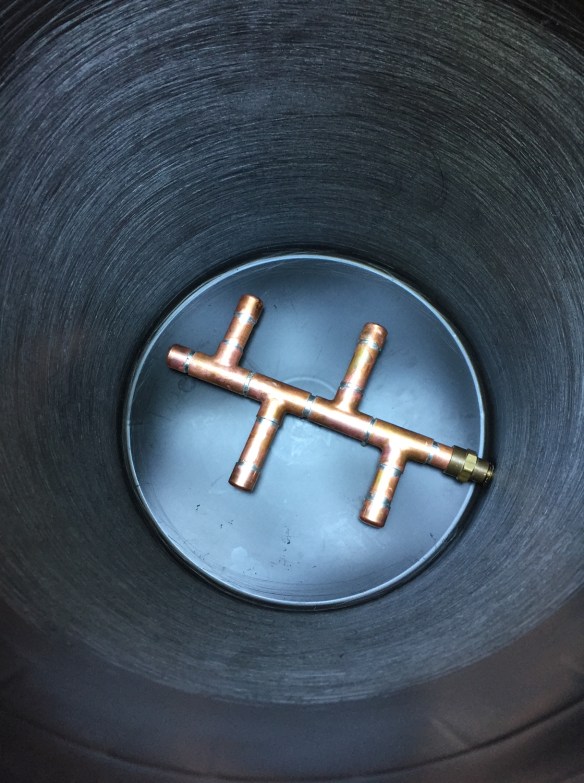
Empty plastic bucket with the copper manifold and outlet

IMG_2402

A couple of notes. I used 40 grit paper on the sides, this is to trap the sand grains and not let any water past the sides. This is a big deal with the slow filters, so I went ahead and treated it. The pipe manifold is copper, there are a bunch of 1/8″ holes underneath that let the water out. I used copper for the antimicrobial properties and easy assembly, but plastic would be fine.  I added a 3″ layer of pea gravel on top of this, to prevent the sand from migrating out the manifold.


IMG_2403

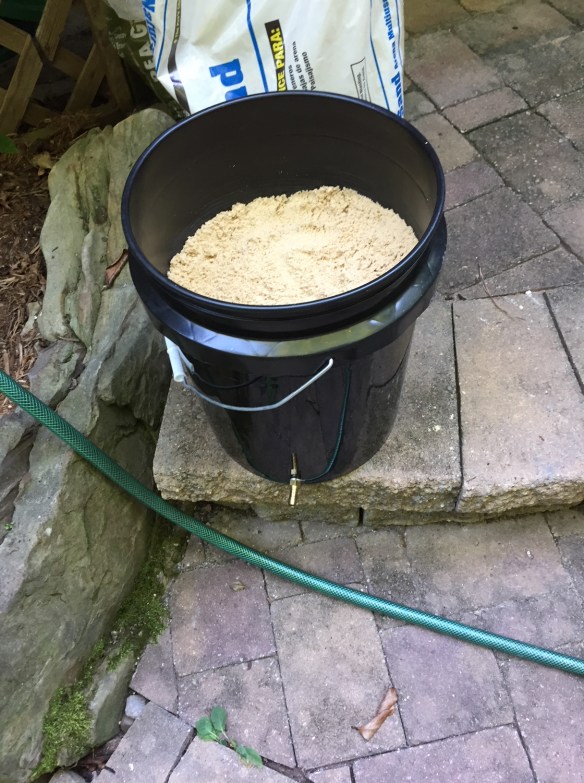
Here it is with the pea gravel and play sand fill. I left about 1 1/2 gallons of headspace to give it some working volume, but still have a filtering action.

IMG_2404

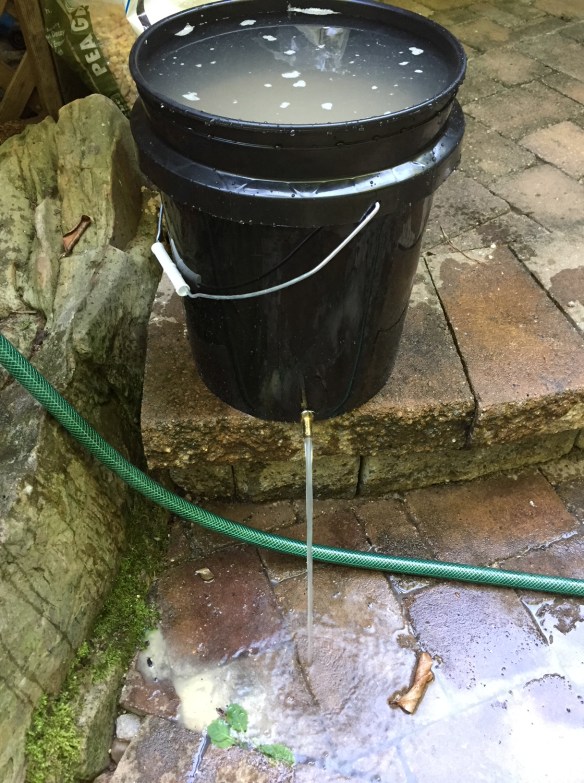
In action. You can see the fine sand it spit out on the first fill, that went away quickly and the rest was crystal clear. Playsand is very fine, almost dust like, and seems to do a good job filtering sediment. I pulled a bucket of pond water, let it sit a few days, then poured it in. Out came nice clear water, albeit with a faint musty lake smell.  This will be run through my other filters soon, and I’ll see how it is. I think using an aquarium bubbler on the filtered water might eliminate the odor, will probably try that as an experiment.

So far, so good though.